Purpose of this blog

Dmitry Yudo aka Overlord, jack of all trades
David Lister aka Listy, Freelancer and Volunteer

Monday, October 29, 2012

[WoT] Digging Through Archives: Czolg P - Polish Maus

In different sources dedicated to Polish armoured vehicles from time to time one can run into various Polish tank projects that didn't make it to real life. Among those projects, there are even heavies, though after a closer look, it appears that at best we would only get Polish counterpart for KV (which is good by itself).

Meanwhile, our guys found a curious document in the bosom of Central Archive of the Russian Ministry of Defence. This document can open the whole new chapter in history of Polish tank development. The vehicle described there is able to top the tree, and, in addition to that, based on its specs, it would make a serious opponent to other high tiers. The author of the project is equally fascinating, as a person is famous in both Poland and abroad. I believe many of his fans have close to no idea about that page of his biography. And in his turn, he avoided mentioning this fact in his memoirs. So, it's sort of exclusive. :)

October 17, 1944. State Defense Commitee received the messaged from the recently freed Lviv. The author of that letter named Projects of technical innovations in defense industry was a certain Stanisław Lem. The message was written in Polish and included illustrations of what the author suggested as aid for Read Army in its struggle with Nazi Germany. The letter covers a number of technical projects, including small tanks, wheel tanks, and even rocket missiles, but we are interested in item N1.


The vehicle, suggested by Stanisław Lem, was named Czolg P (Pancernik) or tank-battleship. According to his concept, the vehicle would weigh 220 t, having 10m length and 4m width. 


Tank would have cast hall. Suggested armament - 152-155mm gun (est.) mounted in main turret, 2 AA machine-guns in the rear, and 4 machine guns in smaller coppulas along the perimeter (one per each). Czolg P would have 4 tracks set in motion by single diesel engine. All in all, that would make a super heavy tank, comparable to any possible opponent. Though, the Soviet Command wasn't interested in the project - there were enough ground cruiser projects at that time.

The original message (PL):


Central Archive of the Russian Ministry of Defence, fund 38, inventory 11350, case N1039

What Czolg P could have as its main armament, based on the range of Polish guns, available that time (1939), is the following: 155MM WZ.40 gun which just as the gun on Czolg P bluepring, had a muzzle break, barrel length of 8.1m, muzzle velocity of 900 m/s, and rate of fire - 3 rpm. That would undoubtedly reduce to ashes any vehicle of that period.


When it comes to AA guns, it's easy - 40 mm WZ.36. And as for low caliber auto guns, this could as well be 20mm Nkm wz. 38 FK.

So generally speaking, Polish Maus would be "independent" and extremely dangerous, especially due to the fact that based on the suggested weight and size, armour thickness would make 200+mm. 

Friday, October 26, 2012

[WoWP] Alpha Gathering

100% unofficial gathering of World of Warplanes alpha testers took palce in National Museum of the US Air Force (near Dayton). Video speaks louder than word:


[WoT] Digging Through Archives: On 8.8 cm PaK 43

Some "archive stuff". The image below represents penetration tests of 8.8 cm PaK (Germany), 122mm D-25T (USSR), and 152mm howitzer ML-20 (USSR) done against IS-3 prototype by Soviets.
 
Central Archive of the Russian Ministry of Defence, fund 38, inventory 11355, case N2943, page 16

IS-3 wasn't impressed at all.

Text above the image:
Front plate of IS-3 is practically immune to contemporary tank guns. The durability of welded plates ensures the required level of protection.
After 7 hits of 88-152mm rounds, the front plate is still good to go. 

Text under the image:
Mark 16: hit by 88mm round from 330m.
Marks 17 and 18: hits by 122mm and 152mm rounds respectively from 690m.

Thursday, October 25, 2012

[ALL] F2P Is Now Online

GDC Online 2012 that took place in Austin, TX (US) earlier in October (9-11) was my first and last GDC Online. That's because the event is changing its format and switching to mobile and tablets, even though F2P market is flourishing nowadays (as well as mobile platforms).

Austin Convetion Center

Among the biggest participants in client-side section (apart from Wargaming :)) were Riot, NCSoft, CCP. Plus there were lots of Zynga-kind ones and a few F2P research companies. All in all, the online version of the GDC appeared to be poorer than the general one held in San Francisco.

While monetization, marketing, and business development talks were mostly ok, the ones on production, programming, and tech were somewhat worse (based on the feedback of our tech guys) - less innovative, although with some nice exceptions.

I will share some my thoughts on the lectures I have visited personally.

AION example.

By making AION EU F2P (which I believe is not strictly correct since they practically adopted hybrid model) NCSoft managed to overcome underpopulation of game servers and significantly boost the revenue. Their steps were focusing on core community (more likely to spend), making purchasable stuff achievable by playing, not flooding the in-game market at once, investments in huge marketing campaign (they needed to sell 2.5-year-old game once again), and going localized (6-digit amounts are spent to produce single pack VO+text).

General F2P trends.

The share of F2P market (US) in game industry went up from 1% (2007) to estimated 10% (2012). While sub-based games reached their plateau back in 2009 with 7+ mln of users, F2P audience has grown from 9 mln (2007) to estimated 42 mln (2012) - that's taking into account web-based and mobile.  F2P has become the dominant MMO revenue model these days, social games (FB) boast ~40$ ARPPU (average revenue per paying user) with conversion to paying user of about 2.5-3.5%. Obviously, client-side MMOs can have noticeably higher conversion rates (up to 25-30%), while for browser games, it's 5-15%.

F2P has become MP3 in games. It's accessible, affordable, interactive.

Having gone F2P the following titles got much better:

  • DC Universe - +1000% CCU (concurrent players) gain, +700% daily revenue
  • Everquest II - +40% daily logins, +300% new players
  • Everquest - +150% daily logins, +125% boost in Item sales, +350% registrations
The new game ecosystem is now the following: eSports + marketing + global community + livecasting (video streaming). The key focus is now on emergent and sandbox gameplay.

How F2P games are monetized.

The basic principles:

  • regular currency is earned through game mechanics
  • premium currency is earned by money spent
  • no two-way conversion allowed.
Item shop should be a natural part of the game, both regular and premium items should be there.

Leveling/tiering is key to monetization: early game -> mid game -> end game, each with the respective items and prices.

Most popular monetization methods:

1. By unlocks
- unlocks and access to high tiers give access to new items
- monetize rarity: sell rare resources

2. By limits
- monetize storage size or inventory size
- monetize limits of economy power (total cap)
- monetize items with less limits

3. By tiers
- monetize accelerated needs of tiers

4. By power variants
- monetize similar but better items
- use 3 or more power variables (price, duration, power)

5. By time
- universal monetizier: more money spent - less time needed

6. By trade
- amount & slots
- frequency
- time

Pricing guidelines:
- tiering, lowest price is assigned to the lowest tier
- have enough flexibility to adjust prices
- account for psycho barriers - 50, 100, 500, 1000, etc
- use matrix for pricing
- going online a bit expensive, raise item amount per money amount spent

I Invite you to the discussion of the F2P stuff.

Tuesday, October 23, 2012

[WoT] Doyle, Kubinka, and Much More. Part 5: Second Answer Bulletin

This post is the continuation of Q&A session with H. L. Doyle, well-known German WWII military exert. See previous post. Doyle's replies are bolded (just in case).

And for a starter - JT's pics from Kubinka as promised some time ago. 


To the interview:


11.    What where the German armies views on the Soviet 122mm and 152mm guns?

The Germans saw the 122mm as powerful and dangerous but the many elements affecting the outcome of battles are complex.  For anyone interested in such matters I would recommend reading two outstanding books edited by my colleague Tom Jentz, namely, “Panzertruppen” Volume 1 and Volume 2.  Chapter 30 in Volume 2 “The last year on the Eastern Front” contains 27 pages of original German reports which reflect their views at this period.

I will just mention a few things:

... the Tiger (with the arrival of 122mm guns) can no longer disregard the (tactical) principles that apply to other types of Panzers...
... statements like “invulnerable” must be wiped out...
On the other hand
... IS tanks usually only engage in a fire fight at long range (2000m)... (where their frontal armour cannot be penetrated)
... the slow rate of fire of IS tanks (must be exploited)
... (Russian) antitank guns are the main opponent of Panzers 

I have not seen mention of the 152mm so it was probably considered comparable to other Artillery weapons of a similar calibre.


12.    Were there any performed test on the Jagdtiger armour, and results?
Prof. Dr. Rau was responsible for German armour design, development and application.  His department set the standards and had very clear procedure for testing armour to ensure it meet the requirements. No Panzer was produced with armour that did not meet the requirements.
As the war progressed the highest specification armour was reserved for Panzers.  Armour of a lesser specification could be produced to give protection against shrapnel and small arms fire to less important weapons such as self-propelled guns.

Test (by all countries) were carried out using their own guns.

13.    Was there ever a design push to move the drive assembly (transmission) of German tanks to the rear, as was found in their Russian counterparts?
Yes, at least at the “experimental” level designers were considering rear mounted final drives as part of “power pack concept” to simplify maintenance.  However, front drive was seen as being a good solution no decision had been taken.

Advanced design of this feature can be seen in the E-10, E-25 projects.  “Project B Antrieb” was the name of drive train project that would have combined a 1200 horsepower Maybach engine with a Mekydro 8-speed combined transmission and steering unit for rear drive in the E-100 but this would have involved moving the motor compartment forward and necessitated an entirely new hull shape.


14.    As we know most German tanks used the Maybach engine series. These petrol engines originally designed for planes.  Did the Germans/Maybach (MTU Today’s) company made any alternative engines for specifically tank usage during the war? If they did why they didn’t implemented them?

Dr. Maybach designed high performance engines for many purposes.  Before the War Germany decided to standardise on Petrol rather than Diesel to simplify logistics.  Because Maybach produced a range of engines with a high performance to weight ratio they were appointed at the supplier of engines for all special Military vehicles such as halftracks and Panzers. 

A specific benefit of Maybach V motors was their exceptionally short length.  This was due to the patented roller bearing system used on the crank shaft.  This compact design meant that the motor compartment could be smaller and the weight of armour needed to protect it was less.

The Maybach HL 230 P30 motor was progressively becoming more reliable despite problems with raw materials.  It delivered 700 horsepower.  Maybach had test versions of a HL234 with fuel injection and other improvements which would have yielded 900 horsepower with no increase in size.

After the War the French employed Maybach to develop the HL295, 1060 horsepower, for their AMX-50.

During the war other German motor manufacturers constantly tried to break the Maybach monopoly without much success.


15. Can you give any additional info about Gas Turbine engine development of Germany in WW2?

Once the power of jet engines had been recognised by German aircraft designers it was inevitable that this new form of motor would be proposed for Panzers.  Some sketches were made showing a turbine in a Tiger II but there is little evidence that this project proceeded.  When I worked with the late Walter Spielberger we published the available sketches of ideas for mounting a jet engine in Tiger in the Motorbuch Verlag book “Der Panzer-Kampfwagen Tiger und seine Abarten” This book is available in English a “Tigers I and II” from Schiffer Publications.


16.    Why did the Germans used welded armour instead of the more effective cast armour (Sherman turret and front hull, some Russian Turrets and hulls) The German engineers couldn't/didn't know the technology how to manufacturing it?

I have not seen any proof that cast armour was any more effective than rolled armour plate. German welding technology was more advanced than that of any of the Allies and this allowed them to effectively weld rolled plates to create flexible designs.  Of course, cast armour was also used when ever complex shapes were involved, e.g. gun mantlets, the front plate of the Jagdtiger fighting compartment.

17.    What info can you give us on the gun penetration tables of German tanks? Which ones do you consider the most reliable?

This is not an area that I personally have paid attention to during my research.  Many such tables were produced by the Germans for different calibre guns and for modifications as they were introduced.  There were tables for different types of ammunition.  From time to time we have included simplified penetration information in our publications but for sure this is subject would be worthy of a well researched dedicated book.

The 7.5cm K.w.K 42 L/70 was the exceptional gun of the period.  It had several good features. It had very good penetration capability, it was more accurate than most guns of that period and it had a high rate of fire.  The ammunition was not too bulky of heavy.  With a well trained crew there was a higher chance of the important first round hit.  The 8.8cm of course had better penetration but was less accurate and took longer to reload.

18.    Which was the Turret which would be most likely built on top of the built E100 chassis?
http://ww2drawings.jexiste.fr/Files/1-Vehicles/Axis/1-Germany/03-sPanzers/E-100/E-100%282%29.htm or
http://www.nast-sonderfahrzeuge.de/fotosammlung/displayimage.php?pid=2552&fullsize=1
Or something else

A turret was designed by Krupp for the E-100.  This was a lighter version, with thinner armour, of the one designed for the Maus II.  I prepared drawings of these turrets for our Panzer Tracts No.6-1 “schwere Panzerkampfwagen Maus and E-100”. No examples of these turrets were constructed.

The vehicles at these sites are fictional creations for entertainment, although the drawings of so-called Jaguar II (E25), Hetzer II (E10) and Jagdpanther II are all based on my published drawings of proposals that had at least reached the drawing board.


19.    Same goes for the Jagdpanzer E100 If such a tank would have been manufactured, what kind of gun would it become, what would its specs be (weight/ armour/ place for the on-top casemate = more likely to be close to Jagdtiger, Ferdinand or Jagdpanther?

If such a project occurred I believe the outcome would have been similar to the Jagdtiger or possibly Jagdpanther as this would have allowed clear access to the motor compartment.  Krupp proposed a Jagdpanther with a 12.8cm gun but to accommodate such a large gun they proposed a fighting compartment at the rear.  I have wondered if removal of the motor would have had to be preceded by dismounting of the gun.  The Ferdinand had two Maybach HL120 that could be removed either side of the gun.

20.    Would it be possible for E-75 and E-50 to have rear transmissions?

Yes, but a lot of design and development work would have been needed. See my answer to Question 13.

To be continued ...

PS. Latest poll results (votes / %):
Rate 8.0 Update for WoT!

Good  - 885 (38%)
Excellent - 861 (37%)
Ok  - 336 (14%)
Poor - 117 (5%)
Bad - 102 (4%)

The new poll is up.

Sunday, October 14, 2012

[WoWP] Airshow Must Go On

MCAS Miramar Air Show 2012 (57th annual) was the first international air event for me to attend and I must say it was amazing.


Miramar is the biggest US event of that kind gathering several hunderds of thousands attendees in just three days that takes place near San Diego.

For us, WG delegation, the first surprise came with the fact that the show takes place on the active Marine Corps Air Station Miramar (after a brief ID check a bunch of ex-commies are allowed in) with F-22 Raptors standing nearby.


These birds are awesome and hardly have any rivals these days.


Chance Vought F4U Corsair. Second-best US WWII performer with kill ratio 11:1 (after Hellcat).


Another iconic naval warrior - Wildcat. This is the F-2M version by GM.


An absolute must have in WoWP, more than 50 years in service. B-52.


WG-Hammer-booth at Miramar.


Patriots Jet Team (6 IL-39s) is performing.


Farmous wall of fire.


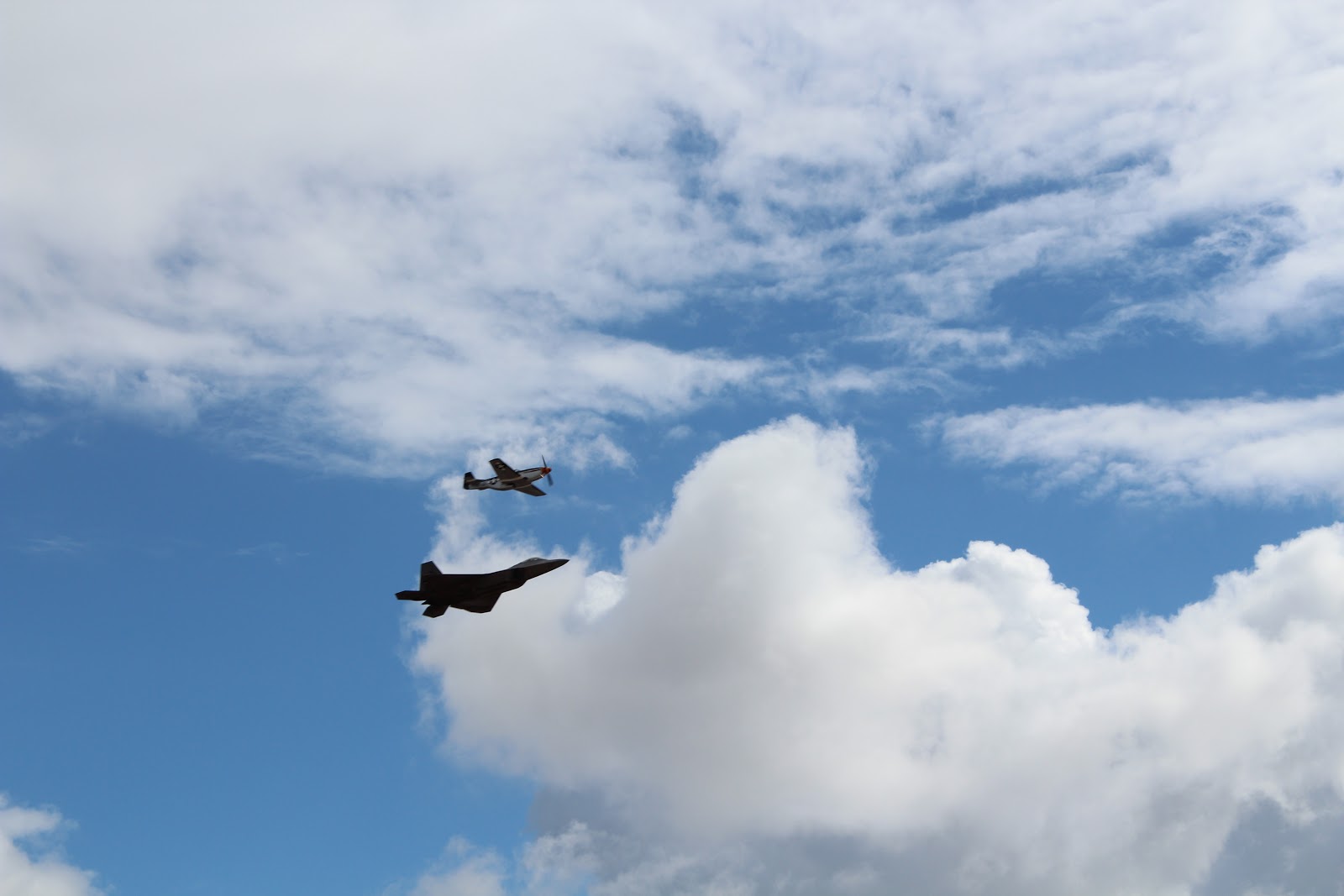
History and modern times: P-51 and F-22. Mustang is nearly blown away. :)


WG producers Serb and ChrisK are discussing what they have seen and how we can use it. 


P-51 Mustang from San Diego Air and Space museum - a real one with S/N, however didn't take part in any action.


Lego-Corsair.


A la Art style.


Serb is nerfing RL aircraft.


A la Art style 2.0.


Some nose-art to add in WoWP in future. 


The show was a real fun, I somewhat skipped some of the delicious parts of it in the post, inclding totally crazy biplane performance with nearly-hit-the-ground maneuvers
  • "pop" U.S. Navy Blue Angels show (those guys are flying without g-suits - hell, yes!)
  • epic Marine Air-Ground Assault Demo with lots of vehicles and infantry
  • deafening F/A-18 Afterburner Passes
  • spectacular night pilotage and fireworks
  • and absolutely awesome Robosaurus! (only those who saw it know what I mean :))
Join us during future major aerial events, we wil double the fun together.

Tuesday, October 9, 2012

[WoT] Doyle, Kubinka, and Much More. Part 4: First Answer Bulletin

Ok, I have given you an opprortunity to ask, now it's time to get answers. Since Doyle's replies are rahter detailed, I am going to break them into issues. Here is the first one and expect more to come in future. Doyle's replies are bolded (just in case)

1. Have you heard of World of Tanks? Do you play it?

World of Tanks has been well known to me for the past couple of years.  I have watched gamers playing and have been very impressed by the graphics and ideas behind the game.  In March 2012 I was delighted to be invited by “Chieftain” to take part, with other reputable authors, in Operation-Think-Tank which was hosted by World of Tanks at the MVTF in California, USA. 

But unfortunately, I do not have time to play World of Tanks, as each year I and my co-author Tom Jentz publish four Panzer Tracts books (we now have a total of over 50 Panzer Tracts covering most of the Panzers and special vehicles used by the Germans). With Panzer Tracts we take an academic approach and present the results of more than forty years research of primary source documents created by those who designed, produced and employed the Panzers. Our ongoing research, which allows us to give the definitive history of Panzers, takes a great deal of time.  In addition I prepare CAD drawings that accurately represent the Panzers “as built”.  It takes hundreds of hours to locate and measure surviving vehicles and components, find original blueprints, for this task. 

2. Would you trust Soviets who had family members killed by Germans in WW2 to impartially make a game about WW2?

What unites us all is our interest in the technical, historical, tactical and strategic aspects of past conflicts.  In over forty years research I have met participants from many nations, none were motivated by the sad aspects of their past history.  So I am certain that our common interest allows us to rise above those personal experiences.

3. The spaced/skirt armour of the Panzer IV and StuG III, Did it have much effect on the battlefield?

Schuerzen plates were a response to a particular threat encountered by the Germans in Russia.  Russian infantry were well equipped with 14.5mm anti-tank rifles.  When Panzers, to achieve an objective, moved ahead of their protecting infantry they were often subjected to side attack from concealed infantry with these antitank rifles.  The medium Panzers: Pz.Kpfw.III, IV and StuG all had 30mm side armour that was vulnerable to multiple 14.5mm antitank rifles hits which could result in mechanical damage and injury to the crews.  Initially it was thought that the side armour would need to be increased but this would have had significant weight consequences and take time to introduce. German designers discovered that 5mm steel plates set at some distance from the side armour was more than enough to dissipate the energy of the anti-tank rifle round before it reached the side armour plate so Schuerzen (Apron) plates were born.

4. Is it possible to assess observed /expected performance of the Panther / Panther II on the battlefield?

The Panther II started as a response to the threat of Russian infantry equipped with anti-tank rifles referred to in Question 3.  The primary request was for heavier side armour.  Of course, once a new design commenced it provided an opportunity for addition new technical ideas to be incorporated.  One of these ideas was to attempt to standardise on components that could be shared with the Tiger II, such as a Maybach Olvar transmission, suspension, wheels etc.  The Panther II was longer and heavier than a normal Panther I.  Although several turret designs were offered no turret was ever mounted on the Versuchsfahrzeuge (test vehicle).  

With the invention of the Schuerzen the gap between the road wheels and the sloped Aufbau (superstructure) of the Panther I could be covered by Schuerzen plates and there was no need for the heavier Panther II. Despite the cancellation of the Panther II project a Panther II Versuchsfahrzeuge (Prototype) was constructed from mild steel and used for research purposes.

This Panther II Versuchsfahrzeuge was taken from the M.A.N factory by the Americans at the end of the war. It was on display at the Fort Knox Museum until 2010.  During a “restoration” in the Seventies a normal Panther Ausf.G turret was mounted for exhibition purposes.  

5. In the "battle" between Henschel and Porsche, did the best designs actually win, or were there other political factors at play and what affect does he think this had on the tanks that emerged?

The different industrial firms always competed to win lucrative design and assembly contracts.  Porsche was an engineer developing innovative solutions and was much admired by the Politicians.  Henschel had an advantage in the competition for what eventually became the Tiger because since late thirties they had been responsible for several heavy tank design projects leading to a trial production series of eight V.K.30.01 (H).  The V.K.30.01 (H) was cancelled as a result of the experience in France in 1940 and intelligence reports which indicated even more powerful tanks would be required by 1942. 

Besides the eight V.K.30.01 (H) tanks, components were used to construct a two trial 12.8cm auf Selbstfahrlafette V. (One of these unique vehicles has been preserved  for all to see at the Kubinka Tank Museum near Moscow)

The next iteration by Henschel designers was the V.K.36.01 (H).  This had had much improved suspension with wider tracks.  But this project was in turn abandoned after one Versuchsfahrzeuge was built because the hull was not wide enough to mount the turret ring needed for a turret with an 8.8cm Gun that was now demanded.  The next version was the V.K.45.01 (H) has many of the features of the V.K.36.01 but with wider superstructure – this became the Tiger I.

Porsche’s first attempt at designing a Panzer was the V.K.30.01 (P).  This had many novel features including: horizontal torsion bar suspension designed to free up space inside the hull and allow for easier replacement, an electric drive train and a new air-cooled engine.  Again this project was cancelled because the superstructure was too narrow to mount a turret with the 8.8cm gun.  Porsche rapidly evolve his design to the V.K.45.01 (P).  One hundred of the Porsche Tiger were ordered but problems with the new air-cooled engine could not be resolved in time. So the Henschel Tiger entered production. The turrets constructed for the Porsche Tiger were mounted on Henschel Tigers.  The Tiger I on display at the Bovington Tank Museum in England has a turret originally intended for a Porsche Tiger

90 of the chassis built for the Porsche Tiger were redesigned to become the basis of the Ferdinand. Fitted with two standard Maybach HL 120 motors the electric drive proved very flexible.  The Ferdinand had the highest kill ratio of all Panzers.

6. I'd like to know whether you preferred Henschel or Porsches designs for things like the eventual Tiger.

During my career as a Tank author I have been fascinated by the technical design and development of the various vehicles.  I cannot really say I prefer one over another.  Every design represents the thinking at a particular point in time.  Technically the Porsche Tiger was very interesting and was very successful when adopted as the Ferdinand.

7. Assuming the basic problems could be overcome - how would the 7002 DB have fared in battled?

There was an endless list of proposed ideas to match each and every discussion. The various Panzer design companies were quick to say “of course we can do that” in the hope that contracts would follow.  At the next discussion sketches were often presented.  But few of these ideas really progressed until a requirement was formulated.

8. What could be further improvements of Jagdpanther?

When the Germans were developing rigid mounted guns for the Jagdpanzer 38t Starr, it was proposed to mount a rigid version of the 8.8cm in a Jagdpanther.  The benefits compared to a normal Jagdpanther would have been the reduced size of gun mount, mantlet and opening in the front plate.  Weight reduction would have improved performance.

9. I would like to ask about tank destroyer on E-100 chassis. Were there any plans of such vehicle or it was just an idea to do somewhere in future tank destroyer on this chassis, but no plans and specifications? In other words, how much true is popular in the internet Jagdpanther-like model E-100 Krokodil?

The E-100 evolved from a suggestion to Krupp that an alternative to the Porsche Maus might be worthwhile give the problems being encountered in the development of the Porsche Tiger. (See my answer to Question 5). While I might have doubts about the requirement for such a heavy Panzer in fact the Porsche Maus proved technically quite successful. To the annoyance of Krupp the E-100 design was turned over to Adler just to continue it as an experimental vehicle.  We have found no documentation to that suggests the E-100 chassis was considered for other purposes.

I have found original drawings for the gun mount and cast mantlet for a 15cm Sturmgeschuetz L/67.  There is indication as to what chassis might have been contemplated for this weapon and the outline of the frontal armour does not fit any of the known designs. I hope to include this drawing in future Panzer Tracts on “Paper Panzers”

10. What was Germans biggest mistake in tanks development and what was their biggest success?

The Germans were slow recognise that suspension with track wider than 400mm would be needed and one of their more powerful (longer) guns should have been mounted earlier.  It must be remembered that narrow track is efficient on paved roads and the Germans were reluctant to have long guns that projecting over the side of their vehicle in built up areas.

The biggest success was the Panther.  It was an excellent all around battle tank with good performance and excellent gun.  The last model Panther Ausf.F which was entering production at the end of the war had a new Schmalturm (Narrow turret) that eliminated shot trap weaknesses of earlier versions.  With experienced well trained crews the Panther was outstanding.
 

Friday, October 5, 2012

[ALL] How We Do Stuff: Building a Bigger Better World. Ending.

Ending. Start here.

Benefits of a light map: terrain without light map & after its introduction


In the coming weeks, expect to hear more about cloud schemes, battling arenas, and water surface rendering. Hope you enjoyed the reading. :)