Friday, June 28, 2013

Thursday, June 27, 2013
[360] Tanks All Around

Taken from here.
Did you have a chance to try the game in beta on during E3 2013? Any thoughts?
I don't own any console and my first PvP experience with WoT 360 happened about 3 weeks ago - found the controls pretty intuitive. Sure thing, gold Xbox Live sub requirement is a kind of entry barrier, unfortunately there was nothing we could. May be MS will drop this as they did with updating fees just recently. :)
And, which side are you on - Xbox One or PS4?
[WoWP] The Right Stuff
Back in the early days of flight people wrestled with
technology they barely understood, with engines that would crash for no reason.
Equally the controls were utter nightmares, and would often lock up at high
speeds or just do something unpredictable, and pitch you into the ground.
To spur on the early pioneers there were many prestigious
prizes.
Now am I talking about WOWP or the real world? The answer is
“both”. I was an Alpha Tester for WoWP, and for a couple of months each week I
would set a challenge for the players to win, and give it an award. The awards
were named after a Person, item or event in aviation history. Required Proof
was a screen shot.
So I figure it would be interesting to revisit those early
days and immortalize the Winners. Keep in mind this was Alpha Testing so the
controls seemed like they were actively trying to kill you, and the graphics
looked bad. Of course the game has also evolved so its likely you will be able to better these numbers, but back in March 2012 it was a very different game.
Claimed Prizes:
John Derry Medal:
For achieving Mach 1. Winner: Trebs, clocking a speed of Mach 1.16.
John Derry was the First Briton to achieve Mach 1. In a later flight in the same aircraft it crashed killing him.
The Mario Pezzi Award:
Highest altitude you can reach in a piston aircraft. Winner: Sgt_Bones with an altitude of 2361m.
Lieutenant Colonel Pezzi set the Propeller driven altitude record. He set it in 1937 (in a bi-plane), and it stands to this day!
Walter Frame Gibb Award:
Highest altitude you can reach in a Jet aircraft. Winner: MartokY with an altitude of 3706m.
Walter Gibb, set the first Turbojet record in 1953, in a Canberra bomber.
Walter Gibb, set the first Turbojet record in 1953, in a Canberra bomber.
Alan Pollock Award:
For Low flying, under a bridge. If there is a tie break, the person who is inverted wins. Winner: GrmlZ, with an altitude of 3m and inverted.
On 5 April 1968 Flight Lieutenant Alan Pollock flew his Hawker Hunter under Tower Bridge.
On 5 April 1968 Flight Lieutenant Alan Pollock flew his Hawker Hunter under Tower Bridge.
Le Prieur award:
Get a Air-to-air kill with a piece of Ordnance, not a gun. Winner: GrmlZ.
Le Prieur rockets were a type of incendiary air-to-air rockets. They were invented by the French Lieutenant Yves Le Prieur and were first used in the Battle of Verdun.
Le Prieur rockets were a type of incendiary air-to-air rockets. They were invented by the French Lieutenant Yves Le Prieur and were first used in the Battle of Verdun.
Unclaimed awards.
(remember applications are closed)
Chuck Yeager Medal:
Doing Mach 1 and surviving! Chuck Yeager was the first Person to do Mach 1 and survive in 1947
HMS Argus award:
For the First Landing! The award is named after the first Aircraft carrier, which conducted the first landing on 1 October 1918.
Scott Crossfield Award:
Doing Mach 2. Scott Crossfield was the first person to do Mach 2 in 1953.
Doing Mach 1 and surviving! Chuck Yeager was the first Person to do Mach 1 and survive in 1947
HMS Argus award:
For the First Landing! The award is named after the first Aircraft carrier, which conducted the first landing on 1 October 1918.
Scott Crossfield Award:
Doing Mach 2. Scott Crossfield was the first person to do Mach 2 in 1953.
Sunday, June 23, 2013
From the Mud...
Before the war Captain Donald Richardson was a Greengrocer.
So when in 1917 he found himself in charge of a section of Tanks its unsurprising
one of them sprouted the name Fray Bentos,
a type of canned meat sold in the UK. Or at least that is the story.


Either way Captain Richardson was himself inside the tank during
the Passchendaele offensive. It was wettest August on record, and by the 23rd
the battlefield was a quagmire.

On that day the section of tanks was detailed to destroy a
selection of German held farms. Although these had been farms before the war,
they were now strong points/ heavily fortified concrete bunkers. Cpt Richardson
led his section from Fray Bentos. Despite
the tank never having been in combat, and all the crew being green the tank
section destroyed the strongpoint at Somme farm. However all the tanks in the
section were bogged down or knocked out, leaving Fray Bentos to continue on alone to destroy Gallipoli Farm.
As the approached the strongpoint a burst of HMG fire hit
the driver’s vision port, the spalling from this burst caused injury to the
face of the driver. As he fell in shock and surprise he caught the control
levers, causing the tank to lurch to one side, and bog down.
Immobilised, high and dry with one sponson pointing into the
mud the other into the sky, a Crewman called Brady volunteered to go outside
and attach the unbogging beam. As he unhooked the beam the same HMG killed him.
However at this point the Sponson gunner spotted the HMG nest and found his 6
pounder gun could just depress enough to hit it, which he did destroying the HMG.
The Germans now brought artillery to bear on the beached
tank. A massive shell impacted alongside the tank punching a splinter into the
chest of one of the sponson Gunners. As the rounds carried on falling the
pounding caused the tank to start to sink sideways. When she stopped sinking
the right sponson was utterly buried, and the left could not depress enough to
do anything. Furthermore the shaking of the shells had caused Brady's body and
the unbogging beam to slide off the tank, blocking the right door, as Cpt
Richardson found out when he tried to lead a party outside to attach the
unbogging beam. Unable to open the door the crew were unable to free the tank.
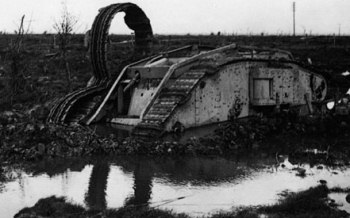
In the early afternoon the Germans launched a counter attack
to re-take Somme farm. Right in their path lay Fray Bentos. Using her Lewis guns she broke up the attack.
Suddenly the tank came under fire from Somme farm as well as
the Germans at Gallipoli and the artillery fire. The British forces as Somme
farm were trying to destroy the tank to stop it being captured by the Germans. Sgt Missen volunteered to act as a runner and
return to Somme farm to let the forces there know of the tanks plight. Crossing
no man’s land in broad daylight, Sgt Missen was wounded. However he did get the
message through.
So for the first day the Germans had been content to bombard
Fray Bentos with everything from
mortars to larger artillery pieces. However overnight they tried something
else. In the early hours after being up for around 24 hours, Cpt Richardson was
startled by the Sponson door being heaved open. Silhouetted against the stars
was the shape of a German soldier with a grenade. Luckily Cpt Richardson
reacted faster, pulling his service revolver and shooting the German. The door
slammed shut as the grenade detonated.
On the MKIV tanks was the sponsons could be retracted into
the hull for transport. The blast of the grenade forced the left hand sponson
to fall into the transport position smashing one of the sponson gunners across
the chest. At this point the Infantry at
Somme Farm started firing up flares to illuminate the battlefield. And they
kept this up for the remainder of the night. To make use of this light the Left
door was used as a hatch, it did involve the crew man tasked with the job to
hold the heavy solid armour door up with one hand while aiming and shooting
with his pistol. This did enable the Tank crew to engage and rout another
sapper party trying to sneak up on them .
At the start of the second day the crew in desperation
started to drink the radiator water from the engines.
During the next 24 hours numerous assault parties were
broken up by either Lewis gun fire or the use of the crew’s personal weapons.
The tank had also provided a bulwark of fire against several German counter
attacks against Somme farm. After three days solid in action, there was only
one unwounded member of the crew, and they'd run out of food and water.
So Cpt Richardson ordered the crew to abandon the vehicle.
They all made it to friendly lines, but to Cpt Richardson’s surprise the crew
manning the Lewis guns had, as standing order required, dismounted the guns and
brought them out with them. Before collapsing through exhaustion Cpt Richardson
turned the Lewis guns over to the infantry's care.

Everyone of the crew later received a gallantry award of some form.
Note: The pictures used in this article are not of Fray Bentos. Another tank bore the same number (F41), and was captured by the Germans. Or are generic stock photographs from the war.
As far as I've been able to tell there are no Photographs of Fray Bentos, apart from one aerial reconnaissance photograph.
Wednesday, June 19, 2013
[WoT] 0.8.6 Hits EU
Major 0.8.6 update has just hit EU and it's time for first-hand feedback on it (NA guys, sorry for the release delay this time).
- tier 10 arty branches
- economy changes including switch to free-2-win and credit income boost
- exp income boost for TDs and SPGs
- game mechanics changes (HEAT, spall liner, camos, accuracy, shell normalization, pen reduction, damage and pen range, velocity reduction for arty shells)
- dynamic camera
- new Korean-style map
- new birds added to Ruinberg and Lakeville
And how is overall performance after 0.8.6?
Sunday, June 16, 2013
[WG] WoWS Is Taking Off
The first WoWS demo took place during E3 and consisted of two 6 vs 6 battles. Players fought US and Japanese destroyers, cruisers, battleships, and carriers.
The scale of action was epic with maps up 100 km in length and width with multiple islands. And there is reason to go large, because battleships (like demoed North Carolina) had effective range up to 40km.
Battles usually began with recon and fighter planes taking off from cruisers and carriers to locate the enemies. While both sides are approaching one another it's time to get a closer look at nicely modeled ships, all based on real-life materials. The attention to detail is impressive, however the decks did look a bit empty without crews dashing about. Well, this is pre-alpha.
Balance is classical: rock - paper - scissors.
Battleships with their heavy but slow guns are weak in close combat, and can't defend against destroyers which are vulnerable against cruisers which have little to withstand battleships' competition.
As for carriers, well, they have no guns worth mentioning. Carriers have a game of their own, using RTS-like UI to control their aerial forces. There is no control of single aircraft of course (go play WoWP), orders are given to entire units.
The goal of the battle is to capture and defend the central area. Players control only main armament - the rest of the guns are automated.
Aiming is done using ballistic reticle that make camera follow shell's trajectory. The trick is to choose the right distance and predict the movement of your enemy so as to strike it hard and not waste your ammo and loading time.
HP bars are in place just like in WoT.
Destroyers are using torpedos which are .. surprised .. powerful. Underwater hits lead to decrease of floatage bar (water incoming!).
Both 10-minute battles were rather fast and dynamic. Who said ships are slowpokes. One of the battles ended with last survived carrier being destroyed by concentrated fire of 2 cruisers and 1 battleship.
All in all it didn't like like swimming tanks, lots of things work differently. The demoed CTF battles took place in the south Pacific and near Orkney islands.
Ready for beta?

The scale of action was epic with maps up 100 km in length and width with multiple islands. And there is reason to go large, because battleships (like demoed North Carolina) had effective range up to 40km.
Battles usually began with recon and fighter planes taking off from cruisers and carriers to locate the enemies. While both sides are approaching one another it's time to get a closer look at nicely modeled ships, all based on real-life materials. The attention to detail is impressive, however the decks did look a bit empty without crews dashing about. Well, this is pre-alpha.
Balance is classical: rock - paper - scissors.
Battleships with their heavy but slow guns are weak in close combat, and can't defend against destroyers which are vulnerable against cruisers which have little to withstand battleships' competition.
As for carriers, well, they have no guns worth mentioning. Carriers have a game of their own, using RTS-like UI to control their aerial forces. There is no control of single aircraft of course (go play WoWP), orders are given to entire units.
The goal of the battle is to capture and defend the central area. Players control only main armament - the rest of the guns are automated.
Aiming is done using ballistic reticle that make camera follow shell's trajectory. The trick is to choose the right distance and predict the movement of your enemy so as to strike it hard and not waste your ammo and loading time.
HP bars are in place just like in WoT.
Destroyers are using torpedos which are .. surprised .. powerful. Underwater hits lead to decrease of floatage bar (water incoming!).
Both 10-minute battles were rather fast and dynamic. Who said ships are slowpokes. One of the battles ended with last survived carrier being destroyed by concentrated fire of 2 cruisers and 1 battleship.
All in all it didn't like like swimming tanks, lots of things work differently. The demoed CTF battles took place in the south Pacific and near Orkney islands.
Ready for beta?

Saturday, June 15, 2013
Flight of the Young eagle
Today I want to take a quick overview of an armoured vehicle that has one of the most remarkable careers I've ever read about.
At the end of World War One conditions in eastern Europe were unique. The two dominating empires (Ottoman and Imperial Russia) had collapsed. This meant that lots of areas with differing ethnicity from the bigger empire saw the chance to try for independence. Of course, if you're setting up a state what sort of government do you want? So within those separate countries you would have competing factions. There were also scattered groups of Anarchists. As most of the countries in the world were rapidly disarming there was also a massive surplus of weaponry for those groups and movements to equip themselves.
In addition to the above, most western governments decided to supply troops to fight the Bolsheviks.
So in the period for the decade after World War One you had a huge swirling pot of conflicting groups. All trying to kill off the other groups. I would mention, this is a bit of an oversimplification.
The other unique thing at the time was that Tanks and other armoured vehicles were more akin to siege weapons. You use them to break a front line. Trains were the important weapon of the age. You could move armies and keep them supplied by train. Rail networks were much more extensive than they are today.
The "tanks" of this type of warfare, providing massive firepower, while protected against most retaliation, were the armoured trains. While most armoured trains are of the style one immediately thinks off, a number of wagons and a single engine. There was another class, engines and weapons were all mounted on one wagon. These are called "Draisine's". Both types were still in use after world war two.
One such Draisine was built in 1916, and this is the remarkable vehicle I wish to look at. When built she was called Zaamurets. Throughout her history could be used with other rolling stock to form various armoured trains. But during this article we're following the life of the Draisine, either as part of a larger train or operating on her own.

Zaamurets has had many names over her years of service; Glory of Ukraine, Polupanov's Boys, Death or Freedom, Lennin, BP-4, Train No 105. However for this article I will use the name she bore for the majority of her time, Orlik ("Young Eagle"). When built she had two 60 HP engines, 16mm of armour and two turrets with full rotation. In a 1917 refit she had 8 Machine guns fitted at various places. Both turrets were armed with 57mm field guns.
Orliks early history is patchy, she has appeared in the service of Both Germans and Imperial Russians. At the time of the Bolshevik Revolution she was at Odessa rail-yards undergoing repairs. During the next year she appears in the service of Ukrainian nationals, Bolsheviks and Germans.
What is certain is in January 1918 the Germans hand her over to a Ukrainian warlord called Skoropadskiy. Within weeks she gets recaptured by the Bolsheviks and is at Kiev.
During March 1918 Orlik is damaged, abandoned and recaptured in fighting against Anarchists. Then repaired and back in the fight, this time against Romanians. There follows a refit at Odessa. After that she is used to fight against German forces, where field guns damage her. To round up a busy month, another refit and redeployment to the 1st Revolutionary Army.
The Czech Legion were a formation of Czech and Slovaks fighting against Germany hoping to win independence for their regions. Due to various reasons the Legion ended up fighting the Bolsheviks and taking control of the Trans-Siberian railway. One of the pieces they captured from the Bolsheviks, at the fighting at Simbrisk (22nd July 1918) was Orlik, as they named her. With no supplies of shells for the 57mm guns they re-armed her with 76mm 1902 field guns.

Whilst in service with the Czech legion, she was briefly owned by the Japanese after they sized her in a Manchurian town. As the Japanese were allied to the Czech legion she was returned after negotiations.

When the Czech legion evacuated from Vladivostok they gifted Orlik to the White Russians who carried on using her to fight the Reds until they evacuated into China in 1922. Orlik then entered Chinese service, serving under several different warlords until 1931 when the Japanese captured her and put her into service.

And that's where the trail dries up. No further records are know of the fate of Orlik. While its a nice image to think of her sitting in some siding somewhere just awaiting re-discovery the turbulent nature of the area, both militarily and politically make it unlikely.
At the end of World War One conditions in eastern Europe were unique. The two dominating empires (Ottoman and Imperial Russia) had collapsed. This meant that lots of areas with differing ethnicity from the bigger empire saw the chance to try for independence. Of course, if you're setting up a state what sort of government do you want? So within those separate countries you would have competing factions. There were also scattered groups of Anarchists. As most of the countries in the world were rapidly disarming there was also a massive surplus of weaponry for those groups and movements to equip themselves.
In addition to the above, most western governments decided to supply troops to fight the Bolsheviks.
So in the period for the decade after World War One you had a huge swirling pot of conflicting groups. All trying to kill off the other groups. I would mention, this is a bit of an oversimplification.
The other unique thing at the time was that Tanks and other armoured vehicles were more akin to siege weapons. You use them to break a front line. Trains were the important weapon of the age. You could move armies and keep them supplied by train. Rail networks were much more extensive than they are today.
The "tanks" of this type of warfare, providing massive firepower, while protected against most retaliation, were the armoured trains. While most armoured trains are of the style one immediately thinks off, a number of wagons and a single engine. There was another class, engines and weapons were all mounted on one wagon. These are called "Draisine's". Both types were still in use after world war two.
One such Draisine was built in 1916, and this is the remarkable vehicle I wish to look at. When built she was called Zaamurets. Throughout her history could be used with other rolling stock to form various armoured trains. But during this article we're following the life of the Draisine, either as part of a larger train or operating on her own.

Zaamurets has had many names over her years of service; Glory of Ukraine, Polupanov's Boys, Death or Freedom, Lennin, BP-4, Train No 105. However for this article I will use the name she bore for the majority of her time, Orlik ("Young Eagle"). When built she had two 60 HP engines, 16mm of armour and two turrets with full rotation. In a 1917 refit she had 8 Machine guns fitted at various places. Both turrets were armed with 57mm field guns.
Orliks early history is patchy, she has appeared in the service of Both Germans and Imperial Russians. At the time of the Bolshevik Revolution she was at Odessa rail-yards undergoing repairs. During the next year she appears in the service of Ukrainian nationals, Bolsheviks and Germans.
What is certain is in January 1918 the Germans hand her over to a Ukrainian warlord called Skoropadskiy. Within weeks she gets recaptured by the Bolsheviks and is at Kiev.
During March 1918 Orlik is damaged, abandoned and recaptured in fighting against Anarchists. Then repaired and back in the fight, this time against Romanians. There follows a refit at Odessa. After that she is used to fight against German forces, where field guns damage her. To round up a busy month, another refit and redeployment to the 1st Revolutionary Army.
The Czech Legion were a formation of Czech and Slovaks fighting against Germany hoping to win independence for their regions. Due to various reasons the Legion ended up fighting the Bolsheviks and taking control of the Trans-Siberian railway. One of the pieces they captured from the Bolsheviks, at the fighting at Simbrisk (22nd July 1918) was Orlik, as they named her. With no supplies of shells for the 57mm guns they re-armed her with 76mm 1902 field guns.

Whilst in service with the Czech legion, she was briefly owned by the Japanese after they sized her in a Manchurian town. As the Japanese were allied to the Czech legion she was returned after negotiations.

When the Czech legion evacuated from Vladivostok they gifted Orlik to the White Russians who carried on using her to fight the Reds until they evacuated into China in 1922. Orlik then entered Chinese service, serving under several different warlords until 1931 when the Japanese captured her and put her into service.

And that's where the trail dries up. No further records are know of the fate of Orlik. While its a nice image to think of her sitting in some siding somewhere just awaiting re-discovery the turbulent nature of the area, both militarily and politically make it unlikely.
Friday, June 14, 2013
[WoTB] Controllers for Blitz
During WWDC in San Francisco Apple announced that it is working on supporting physical controllers in iOS 7.
There going to be at least 3 version of it: 2 form-fitting ones and one standalone. Like this.

Such devices are already in use on Android working via bluetooth for smartphones and tablets.
 Or even this.

We are definitely considering going for them (physical controllers) in World of Tanks Blitz, since it can really improve gaming experience a lot, giving the necessary precision especially for core gamers.
Any thoughts on this?
There going to be at least 3 version of it: 2 form-fitting ones and one standalone. Like this.

Such devices are already in use on Android working via bluetooth for smartphones and tablets.


We are definitely considering going for them (physical controllers) in World of Tanks Blitz, since it can really improve gaming experience a lot, giving the necessary precision especially for core gamers.
Any thoughts on this?
Tuesday, June 11, 2013
[WoWP] Planes Go Open Beta
More news from E3 event. World of Warplanes to go open beta early next month (July 2, 2013).
Expect one more update to 0.4.3 client before that.
Open beta video here.
Remember about 700 battles requirement and unified prem accounts? :)
Expect one more update to 0.4.3 client before that.
Open beta video here.
Remember about 700 battles requirement and unified prem accounts? :)
[WoT] Going 360
This might be a bit late cause I'm right on my marathon Los Angeles - San Francisco - Orlando, but
it is finally happening. WG goes really multiplaftorm with with console project officially announced.
Embrace tank action on consoles! Sign up for the beta here.
it is finally happening. WG goes really multiplaftorm with with console project officially announced.
Embrace tank action on consoles! Sign up for the beta here.
Subscribe to:
Posts (Atom)