Purpose of this blog

Dmitry Yudo aka Overlord, jack of all trades
David Lister aka Listy, Freelancer and Volunteer

Sunday, November 24, 2013

The Prince and the Roman

Contrary to popular belief the Germans didn't have it all their own way in Poland. Polish soldiers gave accounts of themselves that would rival those of the famous German tank and fighter aces. Today we look at one such story.
Roman Orlik
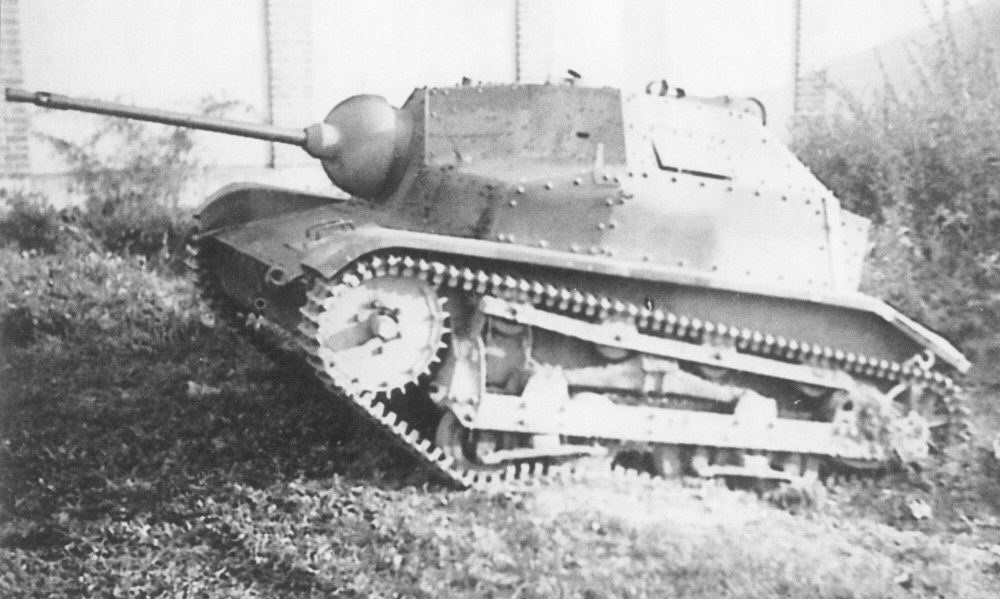
The Germans attacked Poland on 1st of September 1939, two weeks later one Polish soldier would gain notoriety as the first tank ace of the war. Roman Orlik was a lieutenant in the Wolynska Cavalry Brigade. However he didn't ride a horse, he commanded a TKS tankette. The TKS was a small, barely armoured box with Carden-Loyd tracks and a 20mm cannon. Lt Orlik commanded the tankette and manned the gun, his driver was Corporal Zakrzewski.

Lt Orlik's first taste of combat was on the 14th of September. As part of the Polish offensive to drive the Germans back.  As the attack ran out of steam, the Poles made one final push to keep the attack moving. Lt Orlik was positioned on a small hill overlooking the River Bzura towards Brochow. His role was to give covering fire to the attacking infantry.  His fire knocked out three panzers. Although the attack succeeded, ultimately the German resistance was to great, and the Germans resumed the offensive, pushing the Polish forces back.
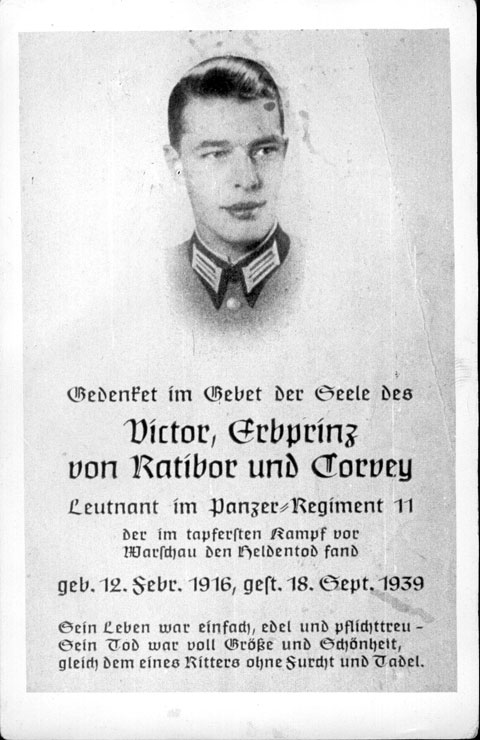
On September the 18th Lt Orlik was placed in command of a patrol, his TKS and two TK-3 tankettes (the same tank armed with only a MG). The patrol was ordered to scout the Kampinoska forest. As the three tankettes approached a crossroads, Lt Orlik heard the sound of engines coming down the road from his right. He ordered the two TK-3's to take cover, then pulled off the road to the left and advanced. As he advanced he saw a patrol of German tanks. Two Panzer 35(t)'s and a Panzer IV Ausf B. The later was commanded by the 23 year old Prince Ratibor.
Prince Ratibor
 Lt Orlik hit the lead Panzer 35(t) as it approached the crossroads. Both the remaining German tanks shifted off the road away from the Polish tankette, and returned fire. They didn't know exactly where the TKS was though, so their fire was wide. Lt Orlik himself had displaced, shifting further back. He then spied the Panzer IV as it passed the crossroads, he emptied a full magazine into the panzers side setting it on fire. As he continued to move left he spotted the remaining Panzer 35(t) through some bushes as it drove along the road, and promptly knocked it out with another burst.
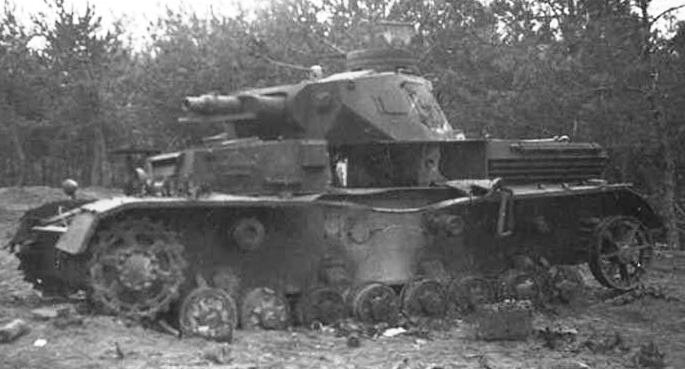
Prince Ratibor's Panzer IV
After the fighting had ended Lt Orlik raced forward to help rescue the crews of the tanks he had destroyed. He managed to save the tank commanders from two of the Panzer 35(t)'s. Prince Ratibor's Panzer IV was engulfed in flames, and the ammunition detonated. Lt Orlik did manage to rescue to badly burnt Prince, however he soon died of his injuries.
One of the captured German officers remarked to Lt Orlik about the TKS:
"...it is very hard to hit such a small cockroach with a gun."
Prince Ratibor's Panzer IV
The next day the Wolynska Cavalry brigade was in position at Sieraków with their 37mm guns looking down the road towards the direction the Germans would come from. Lt Orlik and his platoon were on a wooded hill on the left flank of the road. 27 German tanks, mostly Panzer 35(t)'s advanced on the village at about 1000. Another group attacked further along the line. The Lead German tank advancing down the road was hit by the 37mm AT gun waiting for it. Immediately the Germans deployed off the road and spread out advancing towards the village. This gave Lt Orlik perfect flank shots from his hidden position. In the Fight that followed he knocked out a further seven German tanks. Almost all the German tanks in both groups were smashed.

But again tactical victory wasn't matched by strategic victories. By the 20th Warsaw was nearly fully encircled and under siege. Lt Orlik wasn't finished yet though. He lead another TKS in a night infiltration on the 20th/21st September, and managed to reach Warsaw. He fought until the siege ended.
Lt Orlik survived the war, resuming his job as an architect. In 1995 a book was written about his experiences, and remembering the words of the German tank officer Janusz Magnuski called it "Cockroach Vs Panzers". Roman Orlik died in 1982.


Friday, November 22, 2013

[WoTB] And First Reward

A large and irrelevant image to begin with.


Following first WoT Blitz video "leaked" during G-Star expo in Korea, we have got the first award - "Inven" award for Best Mobile Game of the event (the red one below).

Link (ugh, Korean!) and google translate link (English).

Sure thing, it's a sort of down payment for a game which is not at alpha/beta stage yet. We are approaching this stage, though. So, stay tuned for more.


PS: the second award is for "booth design", afair 

Thursday, November 21, 2013

[WoWP] One Thing That Breaks It All

Ok, while EU and NA World of Warplanes servers are growing pretty good since the release - we have had 3k on NA and 10k on EU (and almost 20k on RU, the release euphoria has somewhat ended and it's time to hate some things.

What is bothering you in World of Warplanes these days? Name just one thing that, if fixed/changed, would substantially improve your experience in aerial combat. If there is one, ofc. :)

I have played 200+ battles to date myself on EU side. And the biggest personal concern would probably be in-game balance and class roles. I didn't really manage to find place for attack aircraft and feel like high-altitude boom-zoom planes are dominating.

Your turn.

UPD. November 25, 2013. Forwarded the topic to dev team, so no more comments from my side. Going to post their response when it's ready. Thanks for your contribution. 
Overlord

Sunday, November 17, 2013

The Battle of the Missiles

The first steps towards guided missiles were taken during World War Two. However these were complex, expensive and unreliable. In the decades following the war missile technology continued to mature. In the late 60's and early 70's missiles became cheap and usable by the majority of troops and their use spread. Although the Yom Kippur War was the first war where missiles had a massive impact they were easily defeated. Equally only one side really employed large amounts of guided weapons. By the 80's many predicted that fierce combat was a thing of the past, with the accuracy and striking power of modern weapons. As is often the case pundits with sweeping statements like that were wrong. Today we'll look at the story of the frigate Joshan and Pykan.
On September 22, 1980, Iraq launched a massive invasion of Iran. Iraq was hoping to use the confusion of the Iranian revolution to become the most powerful gulf state. A vicious fight, that included all the worst aspects of fighting with the added destructiveness of modern technology, erupted for 8 years. However in the first months most of the action was on land and in the air. On October the 28th the Islamic Republic of Iran Navy attempted to change that.

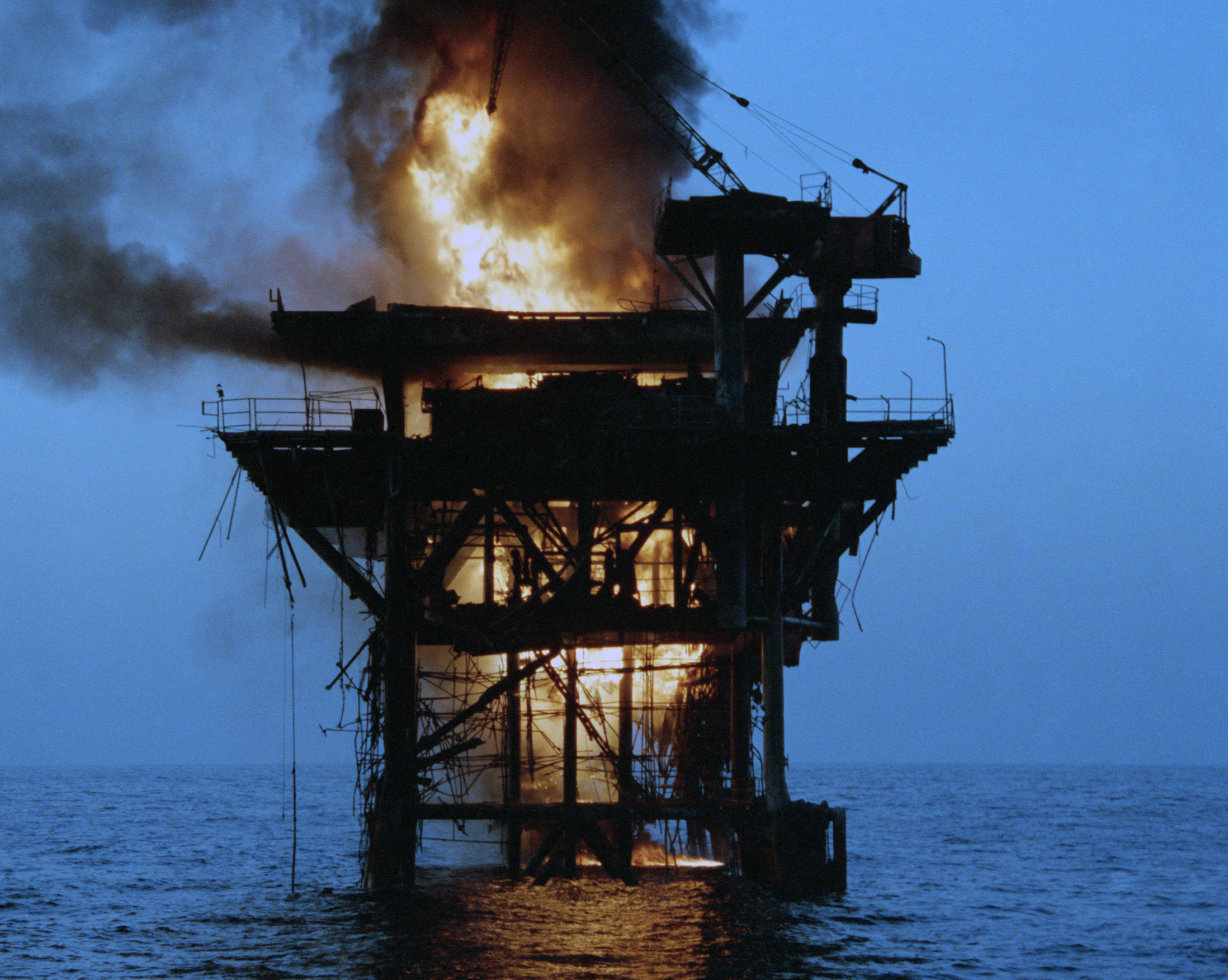
The Iraqi Navy was using two oil platforms in the Gulf as bases for raids against Iranian shipping. They also had installed radar facilities to track Iranian movements. The IRIN dispatched three frigates, the Joshan, Paykan and Gordouneh to shell these platforms. As they opened their attack on the oil platforms. Iraqi Osa fast attack boats fired a spread of missiles at the Iranian frigates. The Paykan launched chaff and all the missiles were decoyed.

In response the Iraqis launched a wave of aircraft to destroy the frigates. The Paykan had several teams of sailors armed with shoulder launched SAM's, and managed to shoot one of the attackers down. The three frigates manoeuvring and speeding towards Iranian waters to avoid the attack were then pounced upon by Iraqi aircraft. All three frigates opened fire with everything they had. Tracers filled the sky, as the three Iranian frigates attempted to defend themselves. The guns on the frigates overheated and jammed from the amount of firing. The Iraqis pressed home their attack, but their bombs exploded wide of the Joshan, the shrapnel did cause some casualties though. As they turned around for another pass on the defenceless frigates two Iraqi planes were blasted out of the sky. Iranian interceptors had arrived to provide cover for the ships. Under air cover the Frigates returned to their base at Bushehr.

On October the 31st the Iranians tried again. This time they set out with air cover. However despite completing their objectives in the face of Iraqi air attacks, the platforms remained operational. The Paykan's SAM teams managed to shoot down another Iraqi jet during this operation.

The Iranians started to draw up a more detailed plan to remove this thorn in their side. It took a month to get everything in place, and on November the 29th Operation Morvarid commenced. Under the cover of air raids aimed at suppressing the Iraqi air force, The Joshan and Paykan took up blocking positions near the two platforms. As before two Iraqi Osa's launched missiles at the Paykan, which decoyed them with chaff. This time the Paykan retaliated with its own missiles. Despite scoring no hits, the missiles convinced the Osa's to withdraw.
With the area secure Iranian commando's stormed the two platforms. Amazingly despite the exchange of missile fire and the air raids going on the mainland the Iraqi defender's were unalerted. Taken completely by surprise the commando's quickly captured or killed all the Iraqi's on board both platforms. As the Iranians set up their demolition charges two Iraqi jets had managed to scramble through the chaos of the covering air raids, reached the platform. Both were instantly shot down by the commando's armed with SA-7 launchers. The Iranians then withdrew. Detonations tore through the platforms, and both burst into flames. The Iraqi's early warning system was gutted, as was the Iraqi's oil flow. On November the 28th Iraqi oil production was 3.25 million barrels a day. On November the 30th it was 550,000. A massive financial blow to a country engaged in a bitter war. But worse was to follow.
After the commando's had retreated, the Paykan and Joshan started to withdraw from their covering positions. The Iraqi navy could now break out of their ports were they'd been bottled up. A force of P-6 combat boats and Osa's attacked the Paykan, again she launched chaff, however one of the missiles saw through the decoys and hit the frigate. Causing damage and casualties. Immediately the Paykan radioed for help, and Iranian jets were dispatched. The Iranian Phantom's hit one of the P-6's with three Maverick missiles blasting it to pieces. The Iraqi vessels fell back. Before the Iranians could finish the Iraqi boats they were engaged in a dogfight with Mig-23's.

With the Iranian air force currently engaged the Paykan was on its own. The frigate managed to sink an Osa with a Harpoon missile, and dodge all the missiles the Iraqi's fired. Then she came under sustained air attack. The Paykan scored one kill with her guns, then one with her SAM's. By now Iraqi helicopters were slamming AT missiles into the frigate. One of them was shot down by return gunfire.

With heavy casualties and damage, almost out of fuel and ammo the Paykan's situation looked grim. The Iraqi's mounted another air attack to finish off the frigate. A pair of Mig-23's hurtled towards the Paykan. Only to be intercepted by Iranian Phantoms. This gave the battered ship one last chance. But again the swarm of Osa's returned. This time the Paykan was out of luck. Two missiles hit her, and she exploded.

The Joshan had also been under attack. Six Iraqi Mig-23's had tried to sink her. However the Iranians having learnt from the Paykan's success in November had deployed SAM teams on the Joshan. Those missiles shot down four of the attacking Iraqi's. A fifth was shot down by a F-14 Tomcat. The sixth fled the battle. The final air strike of the battle was a pair of Iranian Phantom's launching an attack against the Iraqi naval forces. Those two Phantoms sunk another eight craft, although both Phantoms were eventually shot down.

The Iraqi navy had lost 80% of its strength in a single night, in return it had sunk a single frigate. Leaving the Persian Gulf in the control of Iran. Of course these actions later lead to the USA's Operation Preying Mantis, so it might not have been such a victory for Iran.

Friday, November 15, 2013

[WG] Ultimate Tank Factory

I can be a bit slow with this, however -link-


Check out how cool we are :)

[WoTB] First Video

Since the G-Star video of World of Tanks Blitz is already public leaked from Korea, I'm ready to cover your questions, if any. I did notice a few here.  

This is a pre closed beta version with draft UIs (both hangar and battle), somewhat limited in-game functionality, and not final graphics. All in all it has ~85 tanks, 5 maps. It was running on ipads, though Android version is also functioning. 

Other links to the video:

http://youtu.be/EIyuqABv4YU
http://ncsoftst.nowcdn.co.kr//Gstar%202013/131114_WT_ipadplay.mp4

Wednesday, November 13, 2013

[WoWP] Live!

After more than 2.5 years of development second title of the "World of" trilogy goes live - World of Warplanes has already hit RU, EU, and NA servers.

Having been a part of dev team for ~1 year I'm especially proud of that fact.

Join the live servers and provide your feedback. Release is only the beginning.


PS: haters go to hell! :)

Sunday, November 10, 2013

Remembering Jonathan Wilson

Note: Special thanks to Dr T.E Rogers and Marlborough College for their assistance in writing this article, who provided information beyond the questions I asked when conducting the research below. They also supplied some of the photographs. Equally thanks to those who helped with the translations.

Today is Remembrance Sunday in the UK, and for obvious reasons I was debating putting an article up today. However as Remembrance Sunday is a UK only event, and as we have a global readership I decided to do something fitting with the period and still produce an article.
A couple of years ago when researching a British army tank unit I brought a second hand book on the subject. When the book arrived I was surprised to find a sheaf of papers inside it. These were letters from a Soldiers Mother to a friend of the family. The book also had a dedication glued into the front page. From what I can tell the book, and the letters were gifted to a friend of the family who knew the soldier when he was a boy.
This soldiers story has never been seen in one place before, although parts of the story are known. There is no daring-do in this story, no medals. Just a perfect example of the hundreds of thousands of people from around the world who stopped their lives to fight in histories most destructive conflict, and were never able to carry them on. Many of whom have been forgotten by history. At least in this case I can do something about that. So today I give you Jonathan Wilson's story.
Johnathan Wilson in 1942
Jonathan Wilson was born on the 22nd of February 1924. His parents were the singer Sir Steuart Wilson and Ann Wilson (née Bowles). He had 3 siblings. The marriage however was not to last and in 1931 Ann divorced Sir Wilson, something of note in Britain at the time. In 1933 Sir Adrian Boult became Jonathan Wilson's step father.
In September 1937 he enrolled at Marlborough College, where he became an accomplished poet. So much so Marlborough college published about 20 of his works in a book called False Starts. He was still at college when the Second World war started. In 1942 he Captained the Marlborough 1st Rugby XV. In his final year he was also Prefect and the editor of the school magazine "The Marlburian". However as an 18 year old in the middle of World War Two, there was only one option, and he enlisted.

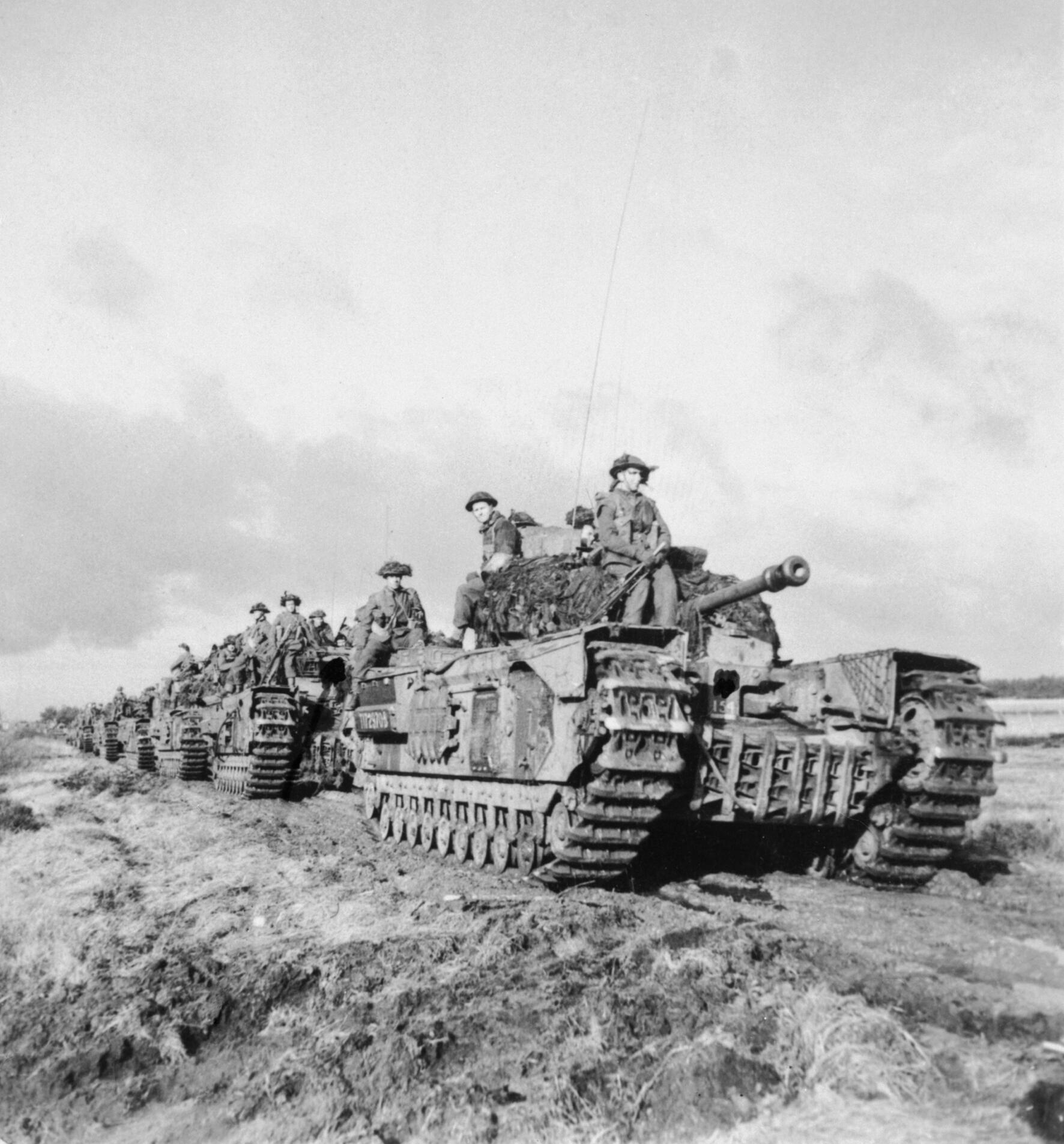
Jonathan Wilson became an officer, and on the 24th of January 1944 he Joined the 3rd Scots Guards while based at Thoresby Park, as a Second Lieutenant. The 3rd Scots were a regiment in the 6th Guards tank brigade. At this time I've yet to be able to find out what role in the Regiment he served in. However on the 19th of September due to an internal promotion Lt Wilson was put in command of a troop in "S" Squadron, although it appears later on he was transferred to command 14 Troop of "Left Flank". His Churchill was named "SPEY", after the Scottish river.

(It should be noted that the Scots guards have an odd way of naming their squadrons. Squadron one is called "Right Flank", Squadron two "S Squadron" and Squadron three is "Left Flank")

Until the late of October the Scots Guards saw no combat, apart from a bombardment against German bunker position at a range of 4000 yards. However on 24th It was realized the Germans had started falling back from the front, and so an advance was ordered. As part of this deployment the Scots were hurriedly pushed forward to seize the village of Moergestel, and its bridge. When they arrived the Scots found the bridge over the canal demolished. The jubilant Dutch townsfolk upon realizing the problem were led by a local priest. Unbidden by the Guardsmen they began gathering boulders and rubble to construct a ford, so the Scots might continue to pursue the retreating Germans. The exuberance shown in this endeavour caused several of the watching officers to fear for their safety as the work was carried out with extreme haste and little care. After a short while the leading tank commander thought he could make it across. On the far bank the Churchill's legendary hill climbing ability failed, and the tank got stuck. However shortly afterwards a bridge-layer arrived and the regiment continued its advance.
A quick push and the Scots worked their way into the outskirts of Tilburg where they started meeting resistance. At this point it appears Lt Wilson's squadron was stuck trying to get through the celebrating Dutch at Moergestel. By the time that Lt Wilson's troop had cleared the traffic jam Tilburg had fallen.  Tilburg was the first large town the Scots had liberated and a massive celebration was under-way. Lt Wilson's troop was moving up to join in the celebration when, much to his troops annoyance they were diverted to the south. A German counter attack had hit and scattered parts of the US 7th armoured Division, and the Scots guards were required to assist. By the time the Scots Guards reached the front the battle was over, broken up by air and artillery power, and the dogged resistance of some US forces.
6th Guards near Tilburg
After being stopped by a peat bog the Scots held in place for a few days until the gains of the German attack had been recovered, and then with the entire brigade was withdrawn to the town of Helmond by November the 7th, where the brigade managed to find billets for everyone. They even managed to set up a club house for writing and recreation. It was named the Churchill Club. The brigade remained there until 20th Of November when a new attack was launched. At 0530 Lt Wilson was given orders to move at speed to a forming up point near Beringe. Lt Wilson's troop moved with such a pace it soon left the rest of the Squadron behind, and managed to reach its destination, shave and have a second breakfast before the rest of the regiment had caught up. The rest of the battalion upon arriving had some comments to say as they drove past the well fed men of Lt Wilson's troop, much to the amusement of Lt Wilson's commanding officer.
3rd Scots Advancing from Beringe
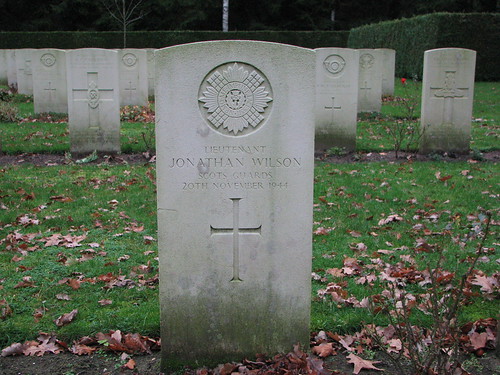
At Beringe the Scots met up with some Achilles tank destroyers and Churchill AVRE's for the next part of the attack towards Sevenum. At 1115 the Squadron in support of the infantry moved out down an isolated track towards Sevenum. After a mile they started to receive heavy mortar and MG fire, which pinned the Infantry. The Churchill's however, could push forward and smash the German positions. The attack ground forwards until the Churchill's were in the houses of Sevenum. Again MG fire pinned the infantry, and the Churchill's drove up and blasted the German positions with point blank fire. 46 Prisoner's were taken. By late afternoon the village was secured, As the tanks reached the other side of the village, about 1700, dusk started to fall. Suddenly from the woods on the right a self-propelled 75mm opened fire, Seconds later another fired from the left. Caught in the crossfire Lt Wilson's tank was knocked out with Jonathan suffering serious injuries. Despite the best efforts of the medical personnel Jonathan Wilson died at about 2300.
Lt Wilson's resting place at Venray
In a coincidence I've only just noticed, on Remembrance Sunday (10th November) 1946, a memorial service was held at Marlborough College Chapel to commemorate and remember those lost during the war. During this service Lord Bishop of Sodor and Man consecrated the South Aisle of the Chapel chancel in memory of Jonathan Wilson. At that Service was Alice Wilson. She carried the book which he'd dedicated to Jonathan's nanny who also attended the ceremony, and the one I brought 60 years later, still with the Order of Service inside the dust jacket.
The Order of Service from the book

Edit on 14/11/13
It appears I made a mistake. I've been contacted by a member of the Wilson family, who helped me clear up a couple of mistakes I made in the main text.

The main mistake was who wrote the letters. The Letters were written by Mrs Wilson, Jonathan's mother. The book was dedicated to Alice Petter, listing Jonathan's rank and position. Mrs Petter was the families nanny/mothers help during the early 30's and would have known Jonathan as child.


Friday, November 8, 2013

[ALL] Matchmaking

What do you think of the current matchmaking in both World of Tanks and World of Warplanes?
Is there anything about it that you don't really like?

How do you like the idea of economic incentives for "underdogs"?

  • individual underdogs (eg tier 8 in tier 10 battle) getting bigger exp bonus for fighting higher tiers, the bigger the tier gap, the bigger the reward. The system is currently in place, however rewards can be bigger. 
  • team underdogs (based on comparison of overall balance weights of all tanks in the two teams) getting some exp bonus for being slightly disadvantaged, eg team that has 1% lower overall weight gets 5% bonus exp regardless of the battle outcome

Sunday, November 3, 2013

Come and Take!

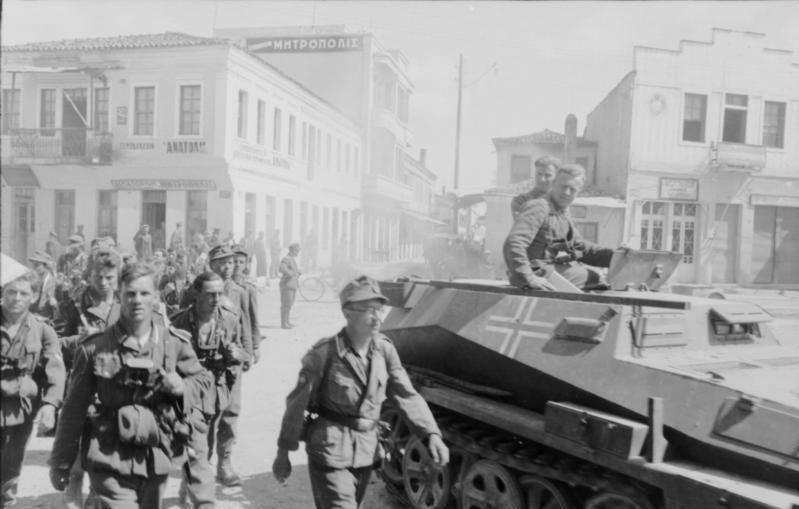
Germanies Blitzkrieg had taken the unprepared allies off guard in 1940. In April 1941 Greece was to experience the same. Honouring her treaty obligations Great Britain deployed a force to Greece to help protect her independence. Today we shall take a look at an action of that campaign.

On the 2nd of March 1941 Commonwealth troops of began landing in Greece. This allied expeditionary force was code named "W Force". Just over a month later, on April the 6th, the Germans attacked. The German Panzer's blitzed through the countryside supported by massive numbers of air craft that overwhelmed the few RAF planes dispatched to the country. Despite stiff resistance the Commonwealth forces were pushed back, and by the 19th The leaders of W Force started contingency planning for evacuation.

The allied forces made one last ditch attempt to hold the Germans. At a place called Thermopylae. Where, 24 centuries earlier, 300 Spartans had stood before a massive army of invading Persians. On the morning of the 21st a New Zealand soldier by the name of Driver James Macdonald was to display bravery that would lead to a military medal. Dvr Macdonald had been dispatched to find fuel supplies. After searching around the chaos of the rear areas he ended up at Levadhia rail yards. Where three trains of ammunition and fuel were located. As his truck was being loaded with the desperately needed supplies the soldiers heard the unmissable scream of Jericho sirens. German Stuka's screeched down onto the yard. The first bombs hit at least one fuel truck setting it ablaze. The spreading pool of fire reached an ammunition pallet and began to cook off the ammunition. The danger of the shells and flames causing the loss of the entire depot in massive explosion was very real. Dvr Macdonald and an Australian Sargent called Killalea both raced towards a one of the trains, which was still loaded with ammunition and fuel. Neither had any clue how to operate the train though. After some quick puzzling over the controls they managed to get the train moving, and drove it through the flames and devastation to safety. Their actions saved 28 wagons of supplies.

The day before the 2/2 Field artillery was travelling over the Brallos Pass, to the west of Thermopylae. they where in a position to ensure the Germans didn't repeat King Xerxes' manoeuvre of outflanking the Spartans at the Hot Gates. As the column of towed guns climbed up the path a section of two 25 Pounders, under the command of Lieutenant Anderson, was ordered to split off and dig in on a tiny ledge located a third of the way down the side of the mountain. Their task was to cover the bridge over the Sperkhios River, and the ground between it and the town of Lamia. The Gun pits were dug a mere 15 feet apart as no other space was available. They were accompanied by Some Infantry and a 2cm Breda AA gun with a British crew.
Their first action, at about 1800 on the 21st, was to fire on some German transports moving towards the river. Opening fire at 10,900 yards they hit and destroyed the first truck, driving the Germans back. At the same time two German reconnaissance Motorcycles approached the Bridge. Unluckily for them the Bridge was being covered by a Carrier platoon, one of the Germans was captured, the other killed. Over night the 8th Potsdam Reconnaissance unit or the 5th Panzer Division filtered into the town of Lamia. At night the gun crews could see the headlights of hundreds of vehicles all filling into the town.

The next morning the Germans attacked. Each time the Germans tried to advance the two 25 Pounders fired. After each salvo of rounds from the Australians, the Germans fired their artillery from beyond a rage that the 25 Pounders could reach. Then the Germans would try to advance again and the situation would repeat itself. After a while the German guns were registered in on the Australian positions. In one of the exchanges of fire a German shell hit an ammo truck causing the rounds inside to cook off. Luckily these were all smoke shells, and a thick cloud blanked the ridge. For 30 minutes the Australians were blinded. As it cleared the Germans began firing again. First a limber was hit and exploded, then a dump of bag charges. These explosions set fire to the undergrowth and soon a the tiny escarpment was ablaze.

The Germans brought up some field pieces and began to fire at the Australian guns, who quickly responded. The guns were in constant action for the entirety of the morning, until about 1300 when one gun sprung a leak in its recoil cylinder due to the number of rounds fired. By this point the German trucks had reached the base of the ridge and were unloading infantry. The crew of the last remaining gun pushed their piece out of its pit to the edge of the escarpment, but the gun wouldn't depress enough. So the Crew lifted the gun by the tail, and while bracing it in their hands began to fire shells at the Germans. Even using the smallest propellant charge the gun was in danger of tearing out of their arms and flipping over. After about 50 shells the Germans began to retreat.

The German response was to use their artillery again. A savage bombardment hit the Australian position,causing the crew to duck. By 4 PM the bombardment lifted and the Gunners found that their 25 Pounder had been knocked out of action. The guns had been in constant action for eight hours, and over 160 German shells had hit the tiny ledge where they had their position. Yet not one casualty had been sustained. Stripping the damaged gun of sights and breech block Lt Anderson sent half his men to safety with the critical parts of the gun. He remained to try and get the first piece working again.

 The Germans landed a furious barrage of shells on the hillside, killing one and wounding one from the first party to retreat. The Gun position was also hit by this whirlwind, killing six and wounding three. As dusk had fallen, the first artillery piece was out of action and couldn't be repaired, Lt Anderson ordered the evacuation of the wounded. Once he had seen them to safety he and Gunner returned, on their own, to the gun position. They put the 25 Pounder beyond use, and collected the discs of the wounded before finally retreating.