Purpose of this blog
Dmitry Yudo aka Overlord, jack of all trades
David Lister aka Listy, Freelancer and Volunteer
Friday, January 17, 2014
Sunday, January 12, 2014
Crocodile, Lets Go!
In early September the US army prepared for its assault on the Fortress of Brest. The city was held by elite German forces, and had been fortified like every other port in the Atlantic Wall. To capture it the United States attacked with the VII Corp. As the US Army stormed into the grinder, the US Generals realised their troops might need some specialist help, and so petitioned the British. From the north, over 400 miles away, a single squadron of tanks was loaded onto transporters. While heavy duty Mack trucks towed their trailers. These were the Crocodiles of B Squadron 141 Royal Armoured Corp.
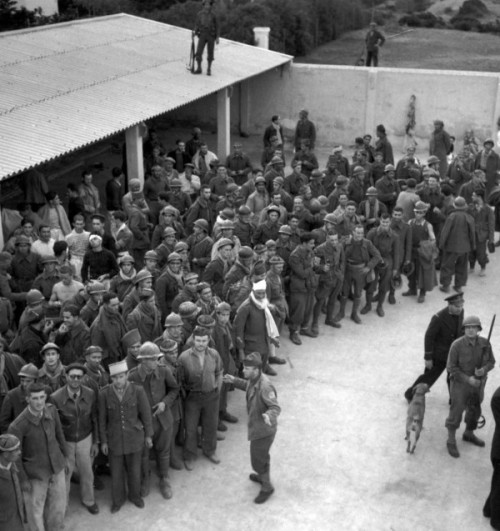
Some of Brest's defences were based on old French forts. A line of these had been prepared and incorporated into the defences. One, Fort Montbarey, was unmanned and was captured on the 11th of September by US infantry. During the rest of the day the infantry suffered heavy shelling. Then a counter attack overnight threw the US infantry back. The Germans set up its positions and defended them by force. Two days later on the 14th the US 29th Infantry Division had prepared for a set piece attack, but by then the Germans were also prepared. Fort Montbarey consisted of three layers of defence. The outer layer was an anti-tank ditch 40 feet wide and 15 feet deep. Inside that area was a mine field made out of 8" naval shells fused to explode on contact. The next line was more wire, earthworks and bunkers. Finally the fortress itself. A sunken road ran around the fortress, with dragons teeth behind that. The walls were made of earth and masonry and were 25 feet thick. Studded with firing slits for small arms. The position was also covered by 20mm AA weapons, that could be depressed to rake the defences outside the fortress. There was also a sprinkling of anti-tank guns. The Defenders themselves were elite Fallschirmjager.
The night before the attack a company of US engineers undertook the deadly task of creating an opening in the minefield. Working in the pitch black they had to find and defuse the 8" shells. All the while avoiding German booby traps. On top of all this they had to do it in silence, lest they alert the defenders. By the morning of the 14th two lines of white tape lay on the ground marking a cleared path. The US infantry were the first to test the path. After they had advanced a troop of Crocodiles was ordered forward to support them. Almost immediately the second Crocodile in the column hit a mine, the driver was killed and the rest of the crew injured. The tank was knocked out as well and couldn't move, blocking the third crocodile. So the engineers returned to their task, creating another swept path around the wrecked tank.
The lead Crocodile continued forward keeping up with the infantry. With the Crocodiles help the infantry pushed forward and managed to get into the sunken road around the fort. The Crocodile began to shore up the position. Blasting apart German positions with its 75mm gun or burning those too stubborn for the gun. That Crocodile remained in action until it had used up all its 75mm ammunition, all of its fuel and almost all of its Besa ammunition. The Germans unable to tackle the Crocodile with the US infantry in close support, and unable to resist the Crocodile, began to surrender. With no more ammunition the Crocodile turned towards friendly lines to re-arm. Almost immediately it got stuck on a tank trap. Seeing their nemesis unable to hurt them, the German troops quickly re-considered and re-occupied their positions. By now things were looking bad for the battered US infantry, Then three more Churchill's arrived.
Unfortunately one fell into a shell hole, one got stuck on a tank trap and the other threw a track. Through out the rest of the day the Allied forces withdrew carefully, clearing the outer defence lines. They captured 122 prisoners on that day, which was over 50% of the defender's manpower. In addition they had knocked out two PAK 38 50mm guns and a 105mm gun. On the 15th the Allies prepared for another assault, eight Fighter bombers worked over the fortress, as did all the available artillery. Meanwhile other allied forces pushed round the flanks to isolate the fortress.
On the 16th the new plan was hatched. Under the cover of US tank destroyers, some Churchill MKV's and all the artillery the allies could lay their hands on a troop of Churchill's advanced on the Fortress. These then proceeded to scour the wall of the fort with fire, under the cover of this wall of flame a Churchill MKVII command tank advanced up to the fort's main gate. Its Commander was Colonel Roy Moss. Col Moss started knocking on the gate with his 75mm. After slamming a few rounds in three Germans emerged to surrender. Two were taken prisoner, while the third was sent back into the fort to ask the commander to surrender his position. Unsurprisingly the German officer refused.
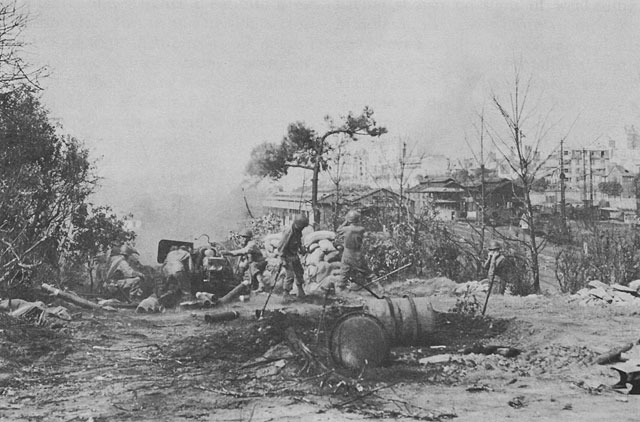
A point blank fire-fight then followed. The US forces manhandled a 105mm howitzer up to the gate and began to pummel it with fire. Col Moss remained in position supporting the artillery piece, while there he was hit in the arm and badly wounded. Col Moss remained in his tank, in position plastering the German defences with fire. Two more troops of Crocodiles advanced on the fort. They began to blanket it with flames. US artillery began to fire HE and white phosphorus into the fort.
Inside the fortress everything was on fire. Out houses were engulfed. Pools of burning fuel from the Crocodiles were spewing clouds of smoke. Through this the concussion of explosives rippled. The defenders were in very real danger of suffocating from the smoke and fumes. Then in a corner they found a box of gas masks. Quickly donning these they survived the onslaught.
After firing 200 rounds from the 105mm aiming over open sights, there wasn't a front gate any more. The US engineers detonated demolition charges ripping open holes in the forts walls. "29, Lets go!" was the motto of the 29th Division, and as they stormed into the fortress they found between 40-80 coughing, breathless, stunned Germans awaiting to surrender. A few Die-hards remained at large in the fort but these were soon routed out.
It was only now that Col Moss, almost unconscious from loss of blood allowed himself to be carried from his scarred tank to receive medical treatment. The US Infantry had taken about 80 causalities on the 14th, but miraculously didn't even suffer one wounded on the 16th.
For his actions that day Col Moss was awarded the Bronze Star.
Some of Brest's defences were based on old French forts. A line of these had been prepared and incorporated into the defences. One, Fort Montbarey, was unmanned and was captured on the 11th of September by US infantry. During the rest of the day the infantry suffered heavy shelling. Then a counter attack overnight threw the US infantry back. The Germans set up its positions and defended them by force. Two days later on the 14th the US 29th Infantry Division had prepared for a set piece attack, but by then the Germans were also prepared. Fort Montbarey consisted of three layers of defence. The outer layer was an anti-tank ditch 40 feet wide and 15 feet deep. Inside that area was a mine field made out of 8" naval shells fused to explode on contact. The next line was more wire, earthworks and bunkers. Finally the fortress itself. A sunken road ran around the fortress, with dragons teeth behind that. The walls were made of earth and masonry and were 25 feet thick. Studded with firing slits for small arms. The position was also covered by 20mm AA weapons, that could be depressed to rake the defences outside the fortress. There was also a sprinkling of anti-tank guns. The Defenders themselves were elite Fallschirmjager.
The night before the attack a company of US engineers undertook the deadly task of creating an opening in the minefield. Working in the pitch black they had to find and defuse the 8" shells. All the while avoiding German booby traps. On top of all this they had to do it in silence, lest they alert the defenders. By the morning of the 14th two lines of white tape lay on the ground marking a cleared path. The US infantry were the first to test the path. After they had advanced a troop of Crocodiles was ordered forward to support them. Almost immediately the second Crocodile in the column hit a mine, the driver was killed and the rest of the crew injured. The tank was knocked out as well and couldn't move, blocking the third crocodile. So the engineers returned to their task, creating another swept path around the wrecked tank.
The lead Crocodile continued forward keeping up with the infantry. With the Crocodiles help the infantry pushed forward and managed to get into the sunken road around the fort. The Crocodile began to shore up the position. Blasting apart German positions with its 75mm gun or burning those too stubborn for the gun. That Crocodile remained in action until it had used up all its 75mm ammunition, all of its fuel and almost all of its Besa ammunition. The Germans unable to tackle the Crocodile with the US infantry in close support, and unable to resist the Crocodile, began to surrender. With no more ammunition the Crocodile turned towards friendly lines to re-arm. Almost immediately it got stuck on a tank trap. Seeing their nemesis unable to hurt them, the German troops quickly re-considered and re-occupied their positions. By now things were looking bad for the battered US infantry, Then three more Churchill's arrived.
Unfortunately one fell into a shell hole, one got stuck on a tank trap and the other threw a track. Through out the rest of the day the Allied forces withdrew carefully, clearing the outer defence lines. They captured 122 prisoners on that day, which was over 50% of the defender's manpower. In addition they had knocked out two PAK 38 50mm guns and a 105mm gun. On the 15th the Allies prepared for another assault, eight Fighter bombers worked over the fortress, as did all the available artillery. Meanwhile other allied forces pushed round the flanks to isolate the fortress.
On the 16th the new plan was hatched. Under the cover of US tank destroyers, some Churchill MKV's and all the artillery the allies could lay their hands on a troop of Churchill's advanced on the Fortress. These then proceeded to scour the wall of the fort with fire, under the cover of this wall of flame a Churchill MKVII command tank advanced up to the fort's main gate. Its Commander was Colonel Roy Moss. Col Moss started knocking on the gate with his 75mm. After slamming a few rounds in three Germans emerged to surrender. Two were taken prisoner, while the third was sent back into the fort to ask the commander to surrender his position. Unsurprisingly the German officer refused.
A point blank fire-fight then followed. The US forces manhandled a 105mm howitzer up to the gate and began to pummel it with fire. Col Moss remained in position supporting the artillery piece, while there he was hit in the arm and badly wounded. Col Moss remained in his tank, in position plastering the German defences with fire. Two more troops of Crocodiles advanced on the fort. They began to blanket it with flames. US artillery began to fire HE and white phosphorus into the fort.
Inside the fortress everything was on fire. Out houses were engulfed. Pools of burning fuel from the Crocodiles were spewing clouds of smoke. Through this the concussion of explosives rippled. The defenders were in very real danger of suffocating from the smoke and fumes. Then in a corner they found a box of gas masks. Quickly donning these they survived the onslaught.
After firing 200 rounds from the 105mm aiming over open sights, there wasn't a front gate any more. The US engineers detonated demolition charges ripping open holes in the forts walls. "29, Lets go!" was the motto of the 29th Division, and as they stormed into the fortress they found between 40-80 coughing, breathless, stunned Germans awaiting to surrender. A few Die-hards remained at large in the fort but these were soon routed out.
It was only now that Col Moss, almost unconscious from loss of blood allowed himself to be carried from his scarred tank to receive medical treatment. The US Infantry had taken about 80 causalities on the 14th, but miraculously didn't even suffer one wounded on the 16th.
For his actions that day Col Moss was awarded the Bronze Star.
Friday, January 10, 2014
[WoT] Missions
Missions functionality has obviously been a great addition to World of Tanks. It has seen a few improvements since the initial implementation.
1. Do you like it now? What you don't like about it? How could the entire system be improved to be more useful?
2. What do you think about personalised missions, i.e. system that would track player's progress throughout the game (tanks researched and purchased, crew skills, etc) and offer unique missions based on that progress? In such a system, each player would always have a goal (or a few) to complete.
3. Missions could also be used for tutorial purposes to explain battle and garage mechanics.
1. Do you like it now? What you don't like about it? How could the entire system be improved to be more useful?
2. What do you think about personalised missions, i.e. system that would track player's progress throughout the game (tanks researched and purchased, crew skills, etc) and offer unique missions based on that progress? In such a system, each player would always have a goal (or a few) to complete.
3. Missions could also be used for tutorial purposes to explain battle and garage mechanics.
Location:
Minsk, Belarus
Sunday, January 5, 2014
Five days that saved a nation
After the First World War the British had taken over governance of most of the middle east, and slowly in the 1920's and 1930's the nations there became independent. After the Second World War the British having bankrupted themselves fighting Germany were slashing the number of military forces they maintained to save money, and so stated to speed up the plans to grant independence to Middle Eastern countries. One such area was the Mandate of Palestine.
During the preceding months before the end of the Mandate, anarchy erupted between the Jews and the Arabs. Many people on both sides were killed in the run up to the British withdrawal. Despite peace talks the situation became worse. Then on the 14th of May, 1948, the British Mandate ended. On the same day the Jewish leaders declared Independence of the state of Israel. The next day the Arab nations invaded. Today we shall have a look at one of those battles.
In the months running up to May 1948 unrest was so bad that most villages in Palestine had quite a large amount of defences and weapons. Equally the roads were very dangerous. The Palmach, fore runner to the Israeli Defence Force, ran supply convoys to many settlements. During the Passover holiday one such convoy reached the settlement of Yad Mordechai, bringing with it Matzo bread, as well as seven Czechoslovakian rifles for the inhabitants. This brought the defenders supplies of weapons up to 37 Rifles, four Sub-machine guns, two machine guns, two light mortars and a PIAT with three rounds.
The settlement itself was aligned South-west to North-east along the main road to Tel Aviv. Its defences were a central command post linked by communications trenches to ten sandbagged sangers around the perimeter fence. The sangers were laid out in a rounded U shape, with the open side of the U leading to a banana plantation on the south west side of settlement. About 300m from the settlement, on the other side of the plantation was a large pillbox.
On May the 15th the Egyptian army crossed the border and began to attack towards Tel Aviv in an attempt to crush the fledgling Israeli state. Two forces totalling 10,000 men, with all the elements of modern warfare, tanks, artillery and air support, began pushing up the roads. Nirim and Kfar Darom were the first two Jewish settlements they came to. The Egyptians attempted to seize both but were held at bay by the defenders. As neither settlement was in their way, they bypassed both and pressed on.
On May the 18th a pair of Spitfires from the Royal Egyptian Air Force made a bombing raid on Yad Mordechai. Realising that they might now be in the front line two of the defenders got hold of a jeep and made a run towards the nearest settlement, Kfar Darom. In part as a reconnaissance, in part to help evacuate the wounded. As they approached they found large Egyptian forces building up. Realising that the Egyptians had to seize an take Yad Mordechai, the two returned with the news of the impending threat. During the night a Palmach convoy arrived and evacuated all the non-combatants from the settlement, leaving about 100 fighters to hold Yad Mordechai.
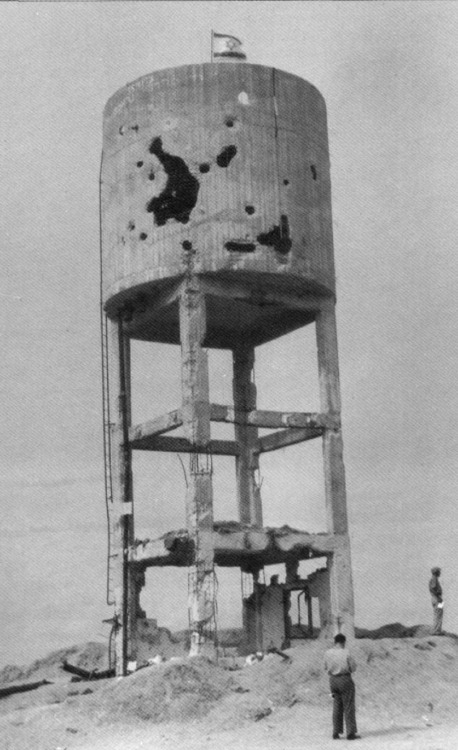
On the morning of the 19th the Egyptians started their attack, with an air strike. The planes showered the settlement with Incendiary bombs setting fire to fuel stores. The situation was made worse by artillery fire, which smashed the settlements water tower.
In the strong-point the seven men defending the position could see the Egyptian army advancing towards them. As they closed the defenders opened fire, throwing the first wave back. The Egyptians brought up armoured cars armed with two pounder guns and began to hammer at the bunker. The Israeli's feared the two pounders, as the shells were described by one veteran as "[...] the red hot shot broke up as it travelled thus forming a fire ball that came at them slowly and with a frightening roar". The defenders threw back the second, and a third assault by Egyptian infantry.
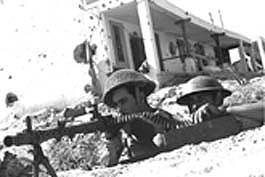
The Egyptians launched a fourth attack. By now the pillbox was peppered with holes, the defenders Thompson sub-machine gun was out of ammunition, and the Bren was so low on rounds it was firing single shots. With little more than rifles the defenders waited until the Egyptians had closed right up with the Bunker then showered them with hand grenades. Most of the force was halted, but a party had managed to flank the bunker, and get into dead ground. With very little ammunition and an increasingly worsening situation the leader of the strong-point ordered his men to retreat back into the settlement.
Following the defenders the Egyptians ran into Sanger's #1 and #2. Both had good fields of fire, but for maximum effect the Commanders ordered their troops to hold fire. When the Egyptians reached the perimeter fence a mere ten meters from position #1 the Israeli's opened fire. Causing heavily casualties. Some Egyptians were forced to take cover behind hte bodies of their fallen friends by the withering salvoes.
Already the defenders supplies of ammunition were getting alarmingly low, so the defenders sent out scavenging parties to collect ammunition from the fallen Egyptians, included in the hall were another twelve PIAT rounds.
The next morning the Egyptians launched a series of attacks on position #1 and #2. Two Infantry Brigades attempted to force the perimeter line. Eight times the brigades attacked, covered by artillery and armoured car fire. The Israeli's pair of 2" mortars kept the armoured cars back, but left a vicious infantry fire-fight. However the defenders managed to hold on and force the Egyptians to fall back. After the last attack was thrown back and evening fell, the Israeli's counted their casualties. There are conflicting reports as to the scale of casualties. One gives the figure of 12 killed and 24 wounded, the other 24 killed and 20 wounded. Either was a significant portion of the defenders manpower now out of the fight. However darkness brought help as well. About 30 Palmach fighters arrived with more ammunition. They also brought the news that radio reports intercepted by the Israeli's had claimed about 300-400 casualties on the Egyptian side.
For the next two days the Egyptians shelled the settlement, constantly. Point blank direct fire from the captured strong-point was also brought to bear along with the artillery fire. Smashing the trench lines the defenders relied upon. During the 22nd under cover of the bombardment the Egyptians managed to push an armoured column along the road. However the bulk of the force couldn't use the same route unless Yad Mordechai was captured.
The 23rd was the final day of the siege. In the morning the Egyptians launched a diversionary attack on Position #10 facing the road on the east side of the settlement. At positions #1 and #2 a smoke screen was laid. When it cleared the defenders could see universal carriers and infantry advancing towards them. The carriers easily smashed the perimeter fence aside, and Infantry advanced into the Israeli line, capturing position #1.
From the banana plantation came another threat. A small force of men and as single Vickers light tank MKVIB pushed into the settlement. As far as I can tell this is the last time a Vickers Light tank saw action. Tanks are difficult to fight in up close, and very disorientating to their crew. The Vickers tank stopped just inside the settlement and began firing its machine gun. Against this bulwark the Israeli's couldn't counter attack to re-capture position #1. They opened fire at the tank with their PIAT, but couldn't score an effective hit. Some defenders attempted to destroy it with fortified grenades. These were two hand grenades tied to a charge of TNT.
Suddenly the tank lurched forward, its crew obviously not relishing the idea of sitting there and being buffeted by the explosions. As it pushed further into Yad Mordechai it bent the defenders line back. Suddenly, as it approached a chicken coup, a defender rushed out and charged the tank. He threw a fortified grenade that detonated beside the drivers vision slit. The Tank ground to a halt. As the unnamed defender attempted again to charge the tank he was hit and killed by a burst of machine gun fire.
The Egyptians tried to recover the tank by towing it away with a second tank. They may have gotten it out of the battlefield, but the tank itself was captured after the war by the Israeli's at a location near Yad Mordechai.
With the tank gone the defenders were able to launch a counter attack that included bitter hand to hand fighting. The attack managed to throw the Egyptians back for a final time.
By now the defenders were almost utterly unarmed, with only a few of their rifles still having ammunition, and even then only a few rounds each. The defence positions were also utterly smashed, more akin to shell holes than identifiable fortifications.
Equally the defenders themselves were utterly exhausted. Having been shelled, bombed and in constant action for five days straight, with little water in the hot summer sun. Knowing the desperation of the situation that night the Palmach sent out a column of ten improvised armoured trucks with ammunition and extra manpower.
The convoy was ambushed before it got close to the settlement. Three of the trucks did make it, but they had not been loaded with supplies. Upon realising the situation the Palmach convoy commander evacuated all the wounded he could carry. Meanwhile knowing that they had done all they could the rest of the defenders abandoned their settlement and retreated to friendly lines.
That there were friendly lines to fall back too was the main success of the defence. Before the war the Israeli's hadn't thought they would be attacked from Egypt, and so hadn't deployed any forces facing their border. If Yad Mordechai hadn't held the Egyptians would have made a clean breakthrough right into the heart of Israel, and we would be living in a very different world. As it was, the five days of resistance allowed the Israeli Defence Forces to establish a blocking force, and the rest is history.
During the preceding months before the end of the Mandate, anarchy erupted between the Jews and the Arabs. Many people on both sides were killed in the run up to the British withdrawal. Despite peace talks the situation became worse. Then on the 14th of May, 1948, the British Mandate ended. On the same day the Jewish leaders declared Independence of the state of Israel. The next day the Arab nations invaded. Today we shall have a look at one of those battles.
In the months running up to May 1948 unrest was so bad that most villages in Palestine had quite a large amount of defences and weapons. Equally the roads were very dangerous. The Palmach, fore runner to the Israeli Defence Force, ran supply convoys to many settlements. During the Passover holiday one such convoy reached the settlement of Yad Mordechai, bringing with it Matzo bread, as well as seven Czechoslovakian rifles for the inhabitants. This brought the defenders supplies of weapons up to 37 Rifles, four Sub-machine guns, two machine guns, two light mortars and a PIAT with three rounds.
The settlement itself was aligned South-west to North-east along the main road to Tel Aviv. Its defences were a central command post linked by communications trenches to ten sandbagged sangers around the perimeter fence. The sangers were laid out in a rounded U shape, with the open side of the U leading to a banana plantation on the south west side of settlement. About 300m from the settlement, on the other side of the plantation was a large pillbox.
On May the 15th the Egyptian army crossed the border and began to attack towards Tel Aviv in an attempt to crush the fledgling Israeli state. Two forces totalling 10,000 men, with all the elements of modern warfare, tanks, artillery and air support, began pushing up the roads. Nirim and Kfar Darom were the first two Jewish settlements they came to. The Egyptians attempted to seize both but were held at bay by the defenders. As neither settlement was in their way, they bypassed both and pressed on.
On May the 18th a pair of Spitfires from the Royal Egyptian Air Force made a bombing raid on Yad Mordechai. Realising that they might now be in the front line two of the defenders got hold of a jeep and made a run towards the nearest settlement, Kfar Darom. In part as a reconnaissance, in part to help evacuate the wounded. As they approached they found large Egyptian forces building up. Realising that the Egyptians had to seize an take Yad Mordechai, the two returned with the news of the impending threat. During the night a Palmach convoy arrived and evacuated all the non-combatants from the settlement, leaving about 100 fighters to hold Yad Mordechai.
On the morning of the 19th the Egyptians started their attack, with an air strike. The planes showered the settlement with Incendiary bombs setting fire to fuel stores. The situation was made worse by artillery fire, which smashed the settlements water tower.
In the strong-point the seven men defending the position could see the Egyptian army advancing towards them. As they closed the defenders opened fire, throwing the first wave back. The Egyptians brought up armoured cars armed with two pounder guns and began to hammer at the bunker. The Israeli's feared the two pounders, as the shells were described by one veteran as "[...] the red hot shot broke up as it travelled thus forming a fire ball that came at them slowly and with a frightening roar". The defenders threw back the second, and a third assault by Egyptian infantry.
The Egyptians launched a fourth attack. By now the pillbox was peppered with holes, the defenders Thompson sub-machine gun was out of ammunition, and the Bren was so low on rounds it was firing single shots. With little more than rifles the defenders waited until the Egyptians had closed right up with the Bunker then showered them with hand grenades. Most of the force was halted, but a party had managed to flank the bunker, and get into dead ground. With very little ammunition and an increasingly worsening situation the leader of the strong-point ordered his men to retreat back into the settlement.
Following the defenders the Egyptians ran into Sanger's #1 and #2. Both had good fields of fire, but for maximum effect the Commanders ordered their troops to hold fire. When the Egyptians reached the perimeter fence a mere ten meters from position #1 the Israeli's opened fire. Causing heavily casualties. Some Egyptians were forced to take cover behind hte bodies of their fallen friends by the withering salvoes.
Already the defenders supplies of ammunition were getting alarmingly low, so the defenders sent out scavenging parties to collect ammunition from the fallen Egyptians, included in the hall were another twelve PIAT rounds.
The next morning the Egyptians launched a series of attacks on position #1 and #2. Two Infantry Brigades attempted to force the perimeter line. Eight times the brigades attacked, covered by artillery and armoured car fire. The Israeli's pair of 2" mortars kept the armoured cars back, but left a vicious infantry fire-fight. However the defenders managed to hold on and force the Egyptians to fall back. After the last attack was thrown back and evening fell, the Israeli's counted their casualties. There are conflicting reports as to the scale of casualties. One gives the figure of 12 killed and 24 wounded, the other 24 killed and 20 wounded. Either was a significant portion of the defenders manpower now out of the fight. However darkness brought help as well. About 30 Palmach fighters arrived with more ammunition. They also brought the news that radio reports intercepted by the Israeli's had claimed about 300-400 casualties on the Egyptian side.
For the next two days the Egyptians shelled the settlement, constantly. Point blank direct fire from the captured strong-point was also brought to bear along with the artillery fire. Smashing the trench lines the defenders relied upon. During the 22nd under cover of the bombardment the Egyptians managed to push an armoured column along the road. However the bulk of the force couldn't use the same route unless Yad Mordechai was captured.
The 23rd was the final day of the siege. In the morning the Egyptians launched a diversionary attack on Position #10 facing the road on the east side of the settlement. At positions #1 and #2 a smoke screen was laid. When it cleared the defenders could see universal carriers and infantry advancing towards them. The carriers easily smashed the perimeter fence aside, and Infantry advanced into the Israeli line, capturing position #1.
From the banana plantation came another threat. A small force of men and as single Vickers light tank MKVIB pushed into the settlement. As far as I can tell this is the last time a Vickers Light tank saw action. Tanks are difficult to fight in up close, and very disorientating to their crew. The Vickers tank stopped just inside the settlement and began firing its machine gun. Against this bulwark the Israeli's couldn't counter attack to re-capture position #1. They opened fire at the tank with their PIAT, but couldn't score an effective hit. Some defenders attempted to destroy it with fortified grenades. These were two hand grenades tied to a charge of TNT.
Suddenly the tank lurched forward, its crew obviously not relishing the idea of sitting there and being buffeted by the explosions. As it pushed further into Yad Mordechai it bent the defenders line back. Suddenly, as it approached a chicken coup, a defender rushed out and charged the tank. He threw a fortified grenade that detonated beside the drivers vision slit. The Tank ground to a halt. As the unnamed defender attempted again to charge the tank he was hit and killed by a burst of machine gun fire.
The Egyptians tried to recover the tank by towing it away with a second tank. They may have gotten it out of the battlefield, but the tank itself was captured after the war by the Israeli's at a location near Yad Mordechai.
With the tank gone the defenders were able to launch a counter attack that included bitter hand to hand fighting. The attack managed to throw the Egyptians back for a final time.
By now the defenders were almost utterly unarmed, with only a few of their rifles still having ammunition, and even then only a few rounds each. The defence positions were also utterly smashed, more akin to shell holes than identifiable fortifications.
Equally the defenders themselves were utterly exhausted. Having been shelled, bombed and in constant action for five days straight, with little water in the hot summer sun. Knowing the desperation of the situation that night the Palmach sent out a column of ten improvised armoured trucks with ammunition and extra manpower.
The convoy was ambushed before it got close to the settlement. Three of the trucks did make it, but they had not been loaded with supplies. Upon realising the situation the Palmach convoy commander evacuated all the wounded he could carry. Meanwhile knowing that they had done all they could the rest of the defenders abandoned their settlement and retreated to friendly lines.
That there were friendly lines to fall back too was the main success of the defence. Before the war the Israeli's hadn't thought they would be attacked from Egypt, and so hadn't deployed any forces facing their border. If Yad Mordechai hadn't held the Egyptians would have made a clean breakthrough right into the heart of Israel, and we would be living in a very different world. As it was, the five days of resistance allowed the Israeli Defence Forces to establish a blocking force, and the rest is history.
Monday, December 30, 2013
[ALL] End of the Year Summary
The end of the year is usually the time to summarize things and events in many spheres.
Let's do that in relation to Wargaming, its games and services.
We did a lot in 2013. Ten (10?) big updates for World of Tanks - my honest opinion is that the game now is better than it ever was. New game modes (finally), HD content (tanks), and many other delicious things are planned for 2014.
We've launched our second game - World of Warplanes. The road to release might have not been perfect all the way through, however the game is steadily becoming better and aiming for a long lifecycle.
World of Warships is already massive and fun to play. It's time is yet to come.
Just as for World of Tanks: Generals and World of Tanks Blitz. Both are coming out earlier. :)
What did you like most and least about us in 2013? What makes you look forward to 2014?
PS: Happy NY!
PPS: Soviet tech tree for WoT Blitz
Let's do that in relation to Wargaming, its games and services.
We did a lot in 2013. Ten (10?) big updates for World of Tanks - my honest opinion is that the game now is better than it ever was. New game modes (finally), HD content (tanks), and many other delicious things are planned for 2014.
We've launched our second game - World of Warplanes. The road to release might have not been perfect all the way through, however the game is steadily becoming better and aiming for a long lifecycle.
World of Warships is already massive and fun to play. It's time is yet to come.
Just as for World of Tanks: Generals and World of Tanks Blitz. Both are coming out earlier. :)
What did you like most and least about us in 2013? What makes you look forward to 2014?
PS: Happy NY!
PPS: Soviet tech tree for WoT Blitz
Location:
Minsk, Belarus
Sunday, December 29, 2013
The Elephant
"Seeing the Elephant" is an American phrase often used to describe the split between those who have seen combat and those who are still unbloodied. In 1942 the US army first saw the elephant against the Axis forces of Europe. On 8th November, 1942. US forces launched operation Torch. The First in a long line of learning experiences that eventually led to the success of Operation Overlord. However at the time the high command of the US forces were apprehensive about their chances of success. Luckily for the US forces they were only fighting the Vichy French.
The Vichy forces had no new equipment since the fall of France, and were at best confused as to where their loyalties lay. On one hand they wanted to help the allies beat Germany, on the other fear of reprisals should the allied invasion fail was in their mind. With this in mind the Vichy forces did put up a fight.
Task force Centre was to land on a beach near Arzew east of Oran. The its main combat arm was elements of the 1st Armoured Division, along with elements from two tank destroyer battalions and infantry units. At this time nothing as complicated as a Landing Ship Tank existed. So the method of getting the tanks ashore was to load the vehicles onto converted tankers and beach them. Once beached, a pontoon bridge could be created to drive the armoured vehicles off the ship.
Luckily the landing was all but unopposed. So the M3 Stuarts, M3 Lee's and M3 GMC's were unloaded without incident. The vehicles of the 1st armoured were split into two groups. Task Force Green and Task Force Red. Both task forces were immediately dispatched to airfields that had been seized earlier by paratroops. TF Red headed to Tafaraoui, which is about 12 miles South east of Oran. The column moved out at about 0800, with M3 GMC Tank destroyers in the lead.
Not meeting any opposition on their route it took about three dusty, hot hours to reach the Airfield. As they approached the US tanks came under fire. The paratroopers were no where in sight. The original plan had called for the 39 C-47's to land at the airfields, and disgorge their cargo's. However, some planes got lost and on approach enemy Anti-aircraft guns had opened up causing the transports to scatter. Of the 39 planes, two landed in neutral Spanish Morocco, and the occupants interned. Two land at the wrong French airfield and were quickly captured. One plane landed at Gibraltar. A group of planes tried to land at the wrong airfield (the one Task Force Green was heading to) but several planes get shot down on the approach by enemy gunfire. The remainder landed at a dried up lake bed of Sebkra d'Oran, many being damaged in the heavy landing.
With the airbase still in enemy hands TF Red launched an immediate attack. After an hours fighting they capture the airfield and 300 Prisoners. Upon hearing the news the paratroopers re-board their Aircraft to fly to the airfield. However the US forces success is short lived. Vichy aircraft appear overhead and they begin to strafe and bomb the defenceless US troops, shooting several of the C-47's down. One M3 GMC receives a direct hit from a 500Lb bomb, and is utterly smashed, although the five man crew is only wounded.
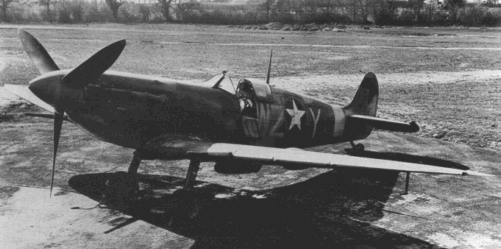
At that point the troops are saved by the Spitfires of the USAAF 31st fighter group, Who had left Gibraltar upon hearing of the airfields capture. The 31st's planes were due to operate from the airfield. Despite being low on fuel the Spitfires dove on the Vichy DW520 fighters and an dogfight erupted. During which the French are driven off, with the US forces claiming three kills, and the French one kill. As always air to air kills are hard to verify. From losses it appears the French may have only lost one and the US none. With no operational transports the paratroopers are forced to walk to the airfield.
Once the paratroopers secured the airfield dusk was falling. So TF Red prepares to spend the night at the airfield before moving out to help TF Green. As dusk falls Vichy artillery begins to fire on the position. Salvo's are scattered, and the tank destroyers return fire. After a while the artillery duel ends inconclusively. What the US troops didn't realize was the artillery fire was the French guns registering for the next mornings fighting.
A troop of M3 GMC's, under the command of Lt Whitsit, and a force of infantry are sent to screen the rear of the airfield position, this detachment reaches a wadi about 800 Meters from the town of St. Lucien and dig in.
On the 9th TF Red moves out about 0750, all the while under French artillery bombardment. Then comes alarming news, the aircraft operating out of Tafaraoui have spotted enemy tanks in St. Lucien! Three platoons of M3 Stuarts are immediately dispatched to help the US troops facing the town, while the rest of TF Red falls back to prepare better positions around the airfield.
The 30 odd Renault 35's of 1e Régiment de Chasseurs d'Afrique, surge out of St. Lucien. The four US tank destroyers open fire. It is curious to note that the M3 GMC is armed with a French made Mle 1897 75mm gun, a weapon with an unbelievably ferocious rate of fire. The four half-tracks pour fire into the oncoming mass of enemy armour. Their shells smashing the pre-war french tanks, whose armour is totally in effective. Then the Stuarts arrive, driving with two platoons forward, and the third in reserve 500m back. Each platoon is in a wedge. Under the cover of the Tank destroyers guns they drive towards the French tanks. In the short fire-fight that follows one Stuart is destroyed, however the Vichy forces are driven from the field, leaving 14 destroyed tanks burning in the desert sun. Then the Spitfires of the 31st attack, routing the enemy regiment.
As he passes beyond the town, his M3 GMC has to swerve a column of French supply trucks parked by the side of the road. A little further on one of Lt Edson's crew looks behind them and realises they are utterly alone, and no other vehicle is following them. Lt Edson brings his half-track about and returns to the fight. As he approaches the truck convoy his battered half-track finally gives up, and breaks down. With nothing further he can do Lt Edson opens fire on the Vichy trucks, which quickly surrender. The US troops order the 50 POW's to be loaded onto a truck, then orders four of the trucks hitched to his immobilized half-track. With that arranged Lt Edson is towed back into the fight.
Only there is not any fighting. The US attack had been thrown back. The French suddenly and unexpectedly find themselves with enemies on both sides, or so it appears. Without letting on, Lt Edson immediately starts to negotiate the surrender terms of the town. At first the French commanding officer refuses to surrender to a mere Lieutenant. Until Lt Edson assures him he is in radio contact with a General. Once the Vichy officer had that assurance he orders his men to stack arms and his officers to hand over their pistols. The entire battalion of 300 combatants surrender.
Shortly afterwards all the Vichy forces surrendered, bringing operation torch to a successful close. The US troops had seen the Elephant, and next on their list was the Afrika Korps. Which would result in the ill fated battle of Kasserine Pass.
The Vichy forces had no new equipment since the fall of France, and were at best confused as to where their loyalties lay. On one hand they wanted to help the allies beat Germany, on the other fear of reprisals should the allied invasion fail was in their mind. With this in mind the Vichy forces did put up a fight.
Task force Centre was to land on a beach near Arzew east of Oran. The its main combat arm was elements of the 1st Armoured Division, along with elements from two tank destroyer battalions and infantry units. At this time nothing as complicated as a Landing Ship Tank existed. So the method of getting the tanks ashore was to load the vehicles onto converted tankers and beach them. Once beached, a pontoon bridge could be created to drive the armoured vehicles off the ship.
Not meeting any opposition on their route it took about three dusty, hot hours to reach the Airfield. As they approached the US tanks came under fire. The paratroopers were no where in sight. The original plan had called for the 39 C-47's to land at the airfields, and disgorge their cargo's. However, some planes got lost and on approach enemy Anti-aircraft guns had opened up causing the transports to scatter. Of the 39 planes, two landed in neutral Spanish Morocco, and the occupants interned. Two land at the wrong French airfield and were quickly captured. One plane landed at Gibraltar. A group of planes tried to land at the wrong airfield (the one Task Force Green was heading to) but several planes get shot down on the approach by enemy gunfire. The remainder landed at a dried up lake bed of Sebkra d'Oran, many being damaged in the heavy landing.
With the airbase still in enemy hands TF Red launched an immediate attack. After an hours fighting they capture the airfield and 300 Prisoners. Upon hearing the news the paratroopers re-board their Aircraft to fly to the airfield. However the US forces success is short lived. Vichy aircraft appear overhead and they begin to strafe and bomb the defenceless US troops, shooting several of the C-47's down. One M3 GMC receives a direct hit from a 500Lb bomb, and is utterly smashed, although the five man crew is only wounded.
At that point the troops are saved by the Spitfires of the USAAF 31st fighter group, Who had left Gibraltar upon hearing of the airfields capture. The 31st's planes were due to operate from the airfield. Despite being low on fuel the Spitfires dove on the Vichy DW520 fighters and an dogfight erupted. During which the French are driven off, with the US forces claiming three kills, and the French one kill. As always air to air kills are hard to verify. From losses it appears the French may have only lost one and the US none. With no operational transports the paratroopers are forced to walk to the airfield.
Once the paratroopers secured the airfield dusk was falling. So TF Red prepares to spend the night at the airfield before moving out to help TF Green. As dusk falls Vichy artillery begins to fire on the position. Salvo's are scattered, and the tank destroyers return fire. After a while the artillery duel ends inconclusively. What the US troops didn't realize was the artillery fire was the French guns registering for the next mornings fighting.
A troop of M3 GMC's, under the command of Lt Whitsit, and a force of infantry are sent to screen the rear of the airfield position, this detachment reaches a wadi about 800 Meters from the town of St. Lucien and dig in.
On the 9th TF Red moves out about 0750, all the while under French artillery bombardment. Then comes alarming news, the aircraft operating out of Tafaraoui have spotted enemy tanks in St. Lucien! Three platoons of M3 Stuarts are immediately dispatched to help the US troops facing the town, while the rest of TF Red falls back to prepare better positions around the airfield.
The 30 odd Renault 35's of 1e Régiment de Chasseurs d'Afrique, surge out of St. Lucien. The four US tank destroyers open fire. It is curious to note that the M3 GMC is armed with a French made Mle 1897 75mm gun, a weapon with an unbelievably ferocious rate of fire. The four half-tracks pour fire into the oncoming mass of enemy armour. Their shells smashing the pre-war french tanks, whose armour is totally in effective. Then the Stuarts arrive, driving with two platoons forward, and the third in reserve 500m back. Each platoon is in a wedge. Under the cover of the Tank destroyers guns they drive towards the French tanks. In the short fire-fight that follows one Stuart is destroyed, however the Vichy forces are driven from the field, leaving 14 destroyed tanks burning in the desert sun. Then the Spitfires of the 31st attack, routing the enemy regiment.
The following morning Lt Whitsit's platoon rejoined TF Red for the push to capture the town of La Senia. As they approach one of his tank destroyers is hit by an enemy shell and the crew killed. Lt Whitsit's platoon is pulled back to join up with the Rest of TF Red and make an end run around the town to capture Oran with TF Green.
However some forces are left to continue the attack. A mixed bag of M3 Lee's and M3 GMC's attempt to push through the town. As resistance stiffens the platoon commander calls back his M3 GMC's to follow the rest of the company around the town. One M3 GMC commanded by Lieutenant Edson had a faulty radio, and doesn't get the message. Lt Edson follows an M3 Lee into town, where they find a roadblock. The Lee Attempts to bull through but becomes stuck and then is hit by a Vichy anti-tank gun. Lt Edson begins to give covering fire until the Crew of the Lee evacuate safely.
Lt Edson realizes his half-track is now the lead vehicle in the column, so leads a charge forward. As he negotiates the roadblock, made even more complicated by the destroyed Lee his vehicle comes under fire. Bumping through the roadblock damages his front brakes which lock partially on. However the tracks still powered by the engine shoves his tank destroyer forward. The smoke pouring off the brakes and front wheels makes it look like his vehicle is on fire and the French gunners ignore him as he surges forward down the clear road.However some forces are left to continue the attack. A mixed bag of M3 Lee's and M3 GMC's attempt to push through the town. As resistance stiffens the platoon commander calls back his M3 GMC's to follow the rest of the company around the town. One M3 GMC commanded by Lieutenant Edson had a faulty radio, and doesn't get the message. Lt Edson follows an M3 Lee into town, where they find a roadblock. The Lee Attempts to bull through but becomes stuck and then is hit by a Vichy anti-tank gun. Lt Edson begins to give covering fire until the Crew of the Lee evacuate safely.
As he passes beyond the town, his M3 GMC has to swerve a column of French supply trucks parked by the side of the road. A little further on one of Lt Edson's crew looks behind them and realises they are utterly alone, and no other vehicle is following them. Lt Edson brings his half-track about and returns to the fight. As he approaches the truck convoy his battered half-track finally gives up, and breaks down. With nothing further he can do Lt Edson opens fire on the Vichy trucks, which quickly surrender. The US troops order the 50 POW's to be loaded onto a truck, then orders four of the trucks hitched to his immobilized half-track. With that arranged Lt Edson is towed back into the fight.
Only there is not any fighting. The US attack had been thrown back. The French suddenly and unexpectedly find themselves with enemies on both sides, or so it appears. Without letting on, Lt Edson immediately starts to negotiate the surrender terms of the town. At first the French commanding officer refuses to surrender to a mere Lieutenant. Until Lt Edson assures him he is in radio contact with a General. Once the Vichy officer had that assurance he orders his men to stack arms and his officers to hand over their pistols. The entire battalion of 300 combatants surrender.
Shortly afterwards all the Vichy forces surrendered, bringing operation torch to a successful close. The US troops had seen the Elephant, and next on their list was the Afrika Korps. Which would result in the ill fated battle of Kasserine Pass.
Wednesday, December 25, 2013
Monday, December 23, 2013
[WoT] Update 0.8.10 Live
How do you like Japanese tanks and improved visuals?
Any other feedback on 8.10 update for World of Tanks which is already live will do as well.
Location:
Minsk, Belarus
Sunday, December 22, 2013
Robotnik!
Note: Many thanks to Wargaming's Cannoneer. Whom found several Russian sources on this subject, when English language sources failed me. Consequently I've had to translate the sources, and any errors are down to Google translate playing word soup with the source material.
In 1920, the Czech writer, Karel ÄŒapek published a play that mentioned a new concept, that of the "Robot". Little did he know less than a decade later one of the worlds armies would be developing a robot tank. These robots actually saw combat in the opening days of the Second World War. Today we shall look at their brief combat history.
In February 1930 the first of a series of tanks that became known as "Teletanks" was tested. The remote control equipment was fitted to a Soviet MS-1. However the high center of gravity meant that the tank would often veer off to one-side. Most Soviet tracked armoured vehicles were tested as Teletanks, eventually the T-26 was selected.
The idea behind the Teletanks was that the remote controlled tank would advance on the enemy lines, and lead the assault, but not risk the crew to enemy fire. The name Teletanks implies some kind of remote monitoring by Television cameras, indeed the first experiments tried this. However Technology at the time was too limited, so the Camera's were dropped from the design. By the early 30's the basic system was decided. A box of 20 buttons, in five rows of four was mounted inside a T-26 tank. These were the command tanks, designated as TU-26's. The remote control tanks were TT-26's.
The boxes would send a radio signal to the TT-26 each time the button was pressed, each button corresponded to a set command. When the radio antenna, located behind bullet proof glass, on the TT-26 received a command it would cause a compressor to fill a balloon with air. Which in turn would move a lever, and so a series of simple pistons would carry out the command.
Due to the tank only being able to operate within visual range of the TU-26, weapon sighting was considered. As the aiming had to be done from a distance, the weapons fitted to the tank were a machine gun and a flame-thrower. The projector could also fire out liquid chemical weapons should it be needed. A smoke generator was also fitted, to provide cover for advances. Finally as a safety feature the TT-26 would automatically shut-down if it went out of radio control range.
The TU-26 command tank was a normal T-26 tank, only with the additional control equipment fitted. So as well as controlling the Robot, the command tank could cover it with its 45mm gun. To protect the secret nature of the tank the command tank could destroy the TT-26 should it become damaged or be in danger of getting captured.
Teletanks were produced for three years from 1935 at factory 174 based in Leningrad. During that time only 33 sets (one TT-26 and one TU-26) were completed. Those tanks were formed into two battalions and an independent company. These were the 152nd and 217th Separate Chemical Tank Battalions. The 152nd took part in the Western Ukrainian campaign of September 1939, but was never used. Later it was stationed near Rovno, where it was bombed by the Germans during Operation Barbarossa.
During December 1939 the Soviets launched an attack on Finland. At Hill 65.5 the Russians ran into Bunker SJ-4, also known as Fort Poppiusa. Part of the Mannerheim line the fort was a complex of bunkers overlooking a valley, at one end of the valley the ground became very boggy, at the other was a lake. In this valley in a five day assault over 1800 Soviet soldiers were killed, and the Red Army soldiers began to call it the Valley of Death.
On December 17th the Teletanks were to be used as designed for the first time. The 1st company with three TT-26's was to scout the Finnish position. Hoping to draw enemy fire and give away the Finnish positions so they could be targeted. The tanks crunched across the thick snow towards the enemy hill. However that snow also camouflaged and covered a line of dragons teeth. All three TT-26's became beached upon the obstacles. Unable to move the Tanks opened fire with both flame-throwers and machine guns, hoping to goad the defenders into giving their locations away. The Finns failed to take the bait. That evening two of the TT-26's were recovered, the other one was stuck fast and couldn't be recovered.
Elsewhere along the line five Teletanks were deployed to support an assault by Russian infantry. Here the snow cover was much thicker and the Teletanks managed to drive over the dragons teeth. However all five were quickly, and easily destroyed by Finnish Anti-tank guns.
On the 10th of February 1940 a new plan was hatched. Three TT-26's were stripped of their turrets and weapons, and filled with as much explosive as could be packed in. Each tank now carried well over two tons of explosives, these tanks were named simply "bombs". Near Hottin lay a large concrete bunker. The three "Bombs" were directed towards it. The Finns saw the approaching tanks and opened fire. Again he poor armour of the T-26 failed, one of the "bombs" was hit and penetrated. A colossal explosion tore the tank apart and disabled the other two.
The final taste of combat for the Robots was between February the 14th and 18th. During this period the tanks were used to try and destroy Finnish minefields, presumably with their flame-throwers. Four TT-26's were lost to hitting mines.
Earlier in February the OKMO plant in Leningrad, had unveiled the next generation of Teletanks. It was an officially produced "bomb". The armour had been reinforced with an additional 50mm, and it had a detachable container with a 700Kg explosive charge. The first of these arrived in Finland on the 28th of February, even so it didn't see service. It was tested against Finnish bunkers after the Soviet breakthrough. In one test the charge blasted apart five of the sturdy dragons teeth. In the next test against Fort Poppiusa, the charge destroyed the bunker.
The story of the 217th Battalion isn't quite over yet. As the Germans approached Moscow in late 1941, the battalion had been brought back up to full strength. There was no need for remote controlled tanks for attacking heavily defended lines in the new Blitzkrieg war. So the special equipment was replaced by 45mm guns, and the tanks manned with crews. The TT-26's fought their last battle as normal T-26 tanks defending the Russian capital.
In 1920, the Czech writer, Karel ÄŒapek published a play that mentioned a new concept, that of the "Robot". Little did he know less than a decade later one of the worlds armies would be developing a robot tank. These robots actually saw combat in the opening days of the Second World War. Today we shall look at their brief combat history.
In February 1930 the first of a series of tanks that became known as "Teletanks" was tested. The remote control equipment was fitted to a Soviet MS-1. However the high center of gravity meant that the tank would often veer off to one-side. Most Soviet tracked armoured vehicles were tested as Teletanks, eventually the T-26 was selected.
The idea behind the Teletanks was that the remote controlled tank would advance on the enemy lines, and lead the assault, but not risk the crew to enemy fire. The name Teletanks implies some kind of remote monitoring by Television cameras, indeed the first experiments tried this. However Technology at the time was too limited, so the Camera's were dropped from the design. By the early 30's the basic system was decided. A box of 20 buttons, in five rows of four was mounted inside a T-26 tank. These were the command tanks, designated as TU-26's. The remote control tanks were TT-26's.
The boxes would send a radio signal to the TT-26 each time the button was pressed, each button corresponded to a set command. When the radio antenna, located behind bullet proof glass, on the TT-26 received a command it would cause a compressor to fill a balloon with air. Which in turn would move a lever, and so a series of simple pistons would carry out the command.
Due to the tank only being able to operate within visual range of the TU-26, weapon sighting was considered. As the aiming had to be done from a distance, the weapons fitted to the tank were a machine gun and a flame-thrower. The projector could also fire out liquid chemical weapons should it be needed. A smoke generator was also fitted, to provide cover for advances. Finally as a safety feature the TT-26 would automatically shut-down if it went out of radio control range.
The TU-26 command tank was a normal T-26 tank, only with the additional control equipment fitted. So as well as controlling the Robot, the command tank could cover it with its 45mm gun. To protect the secret nature of the tank the command tank could destroy the TT-26 should it become damaged or be in danger of getting captured.
Teletanks were produced for three years from 1935 at factory 174 based in Leningrad. During that time only 33 sets (one TT-26 and one TU-26) were completed. Those tanks were formed into two battalions and an independent company. These were the 152nd and 217th Separate Chemical Tank Battalions. The 152nd took part in the Western Ukrainian campaign of September 1939, but was never used. Later it was stationed near Rovno, where it was bombed by the Germans during Operation Barbarossa.
During December 1939 the Soviets launched an attack on Finland. At Hill 65.5 the Russians ran into Bunker SJ-4, also known as Fort Poppiusa. Part of the Mannerheim line the fort was a complex of bunkers overlooking a valley, at one end of the valley the ground became very boggy, at the other was a lake. In this valley in a five day assault over 1800 Soviet soldiers were killed, and the Red Army soldiers began to call it the Valley of Death.
On December 17th the Teletanks were to be used as designed for the first time. The 1st company with three TT-26's was to scout the Finnish position. Hoping to draw enemy fire and give away the Finnish positions so they could be targeted. The tanks crunched across the thick snow towards the enemy hill. However that snow also camouflaged and covered a line of dragons teeth. All three TT-26's became beached upon the obstacles. Unable to move the Tanks opened fire with both flame-throwers and machine guns, hoping to goad the defenders into giving their locations away. The Finns failed to take the bait. That evening two of the TT-26's were recovered, the other one was stuck fast and couldn't be recovered.
Elsewhere along the line five Teletanks were deployed to support an assault by Russian infantry. Here the snow cover was much thicker and the Teletanks managed to drive over the dragons teeth. However all five were quickly, and easily destroyed by Finnish Anti-tank guns.
On the 10th of February 1940 a new plan was hatched. Three TT-26's were stripped of their turrets and weapons, and filled with as much explosive as could be packed in. Each tank now carried well over two tons of explosives, these tanks were named simply "bombs". Near Hottin lay a large concrete bunker. The three "Bombs" were directed towards it. The Finns saw the approaching tanks and opened fire. Again he poor armour of the T-26 failed, one of the "bombs" was hit and penetrated. A colossal explosion tore the tank apart and disabled the other two.
The final taste of combat for the Robots was between February the 14th and 18th. During this period the tanks were used to try and destroy Finnish minefields, presumably with their flame-throwers. Four TT-26's were lost to hitting mines.
Earlier in February the OKMO plant in Leningrad, had unveiled the next generation of Teletanks. It was an officially produced "bomb". The armour had been reinforced with an additional 50mm, and it had a detachable container with a 700Kg explosive charge. The first of these arrived in Finland on the 28th of February, even so it didn't see service. It was tested against Finnish bunkers after the Soviet breakthrough. In one test the charge blasted apart five of the sturdy dragons teeth. In the next test against Fort Poppiusa, the charge destroyed the bunker.
The story of the 217th Battalion isn't quite over yet. As the Germans approached Moscow in late 1941, the battalion had been brought back up to full strength. There was no need for remote controlled tanks for attacking heavily defended lines in the new Blitzkrieg war. So the special equipment was replaced by 45mm guns, and the tanks manned with crews. The TT-26's fought their last battle as normal T-26 tanks defending the Russian capital.
Thursday, December 19, 2013
[WoWP] First Post-Release Update
First post-launch update for World of Warplanes is now live for EU&NA servers, bringing:
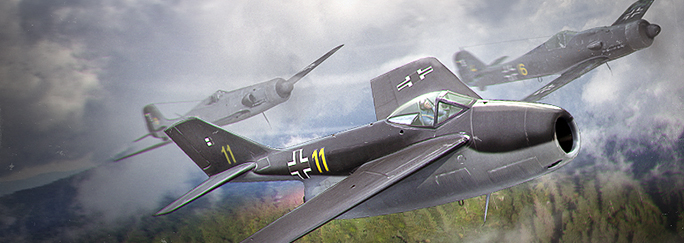
- Focke-Wulf branch for Germany
- Two brand new maps - Adriatic & Fortress
- A set of tier 5 prems - 5 units
- New achievements (11)
And most importantly balancing (including high-altituide aircraft nerfing) and camera adjustments.
So, how is the gameplay right now?
Location:
Orlando, FL, USA
Subscribe to:
Posts (Atom)