Purpose of this blog

Dmitry Yudo aka Overlord, jack of all trades
David Lister aka Listy, Freelancer and Volunteer

Sunday, February 9, 2014

Chief of Battle: Part one

In the late 40's the British started looking for a new design of tank to replace their Centurions.  However, nothing came of that programme and the Centurions remained in service. A decade later the same idea came up again.

Design started in the early 1950's on the Medium Gun tank No 2, renamed in 1962 to the FV4201. The two main requirements were for survivability and firepower.  These requirements were due entirely to the expected threat of the Warsaw Pact forces.
In line with with NATO it was decided to fit multi-fuel engines to all new tanks.  Everyone else quickly realised this was impractical, however, despite reservations the Chieftain was fielded with such an engine.  It is safe to say that the engine was the thing that broke the tank.
The L60 multi-fuel engine was based on parts from a World War Two era Junkers Jumo engine, the same type as those fitted to the various German bombers!  It was also built by a company that had a less than stellar reputation in the motoring industry.  The engine performance was so poor that when in 1960 automotive trials were carried out, the tank actually failed to finish.
Conqueror, Centurion and Chieftain
In other aspects, the tank was excellent.  The 120mm L11 gun provided unmatched range, precision and killing power.  At the time nearly all tanks were armed with guns of around 100mm calibre.  The split case ammunition was found not to lower the tanks rate of fire and it enabled many advantages such as the ability to store all explosives below the level of the turret ring, while the solid armour piercing rounds could be stored in the turret.

The armour protection to the front of the tank was provided by cast armour inspired by an IS2 the British had found under a collapsed block of flats in Berlin in 1945. The casting of the turret was so thick that each one had to cool for one year.

In 1962 two tanks were given to the British army for testing in the German winter.  At first the crews loved the ability for the tracks to grip the ground, and the handling was deemed to be excellent.  Then the crews realised the tank lacked a heater.

The lack of a heater wasn't as much of an issue in Iran.  By the time of the 1979 revolution the Iranian army had brought about 700 Chieftains.  At the end of 1980 when the Iran-Iraq war broke out, those Chieftains were still crewed by experienced well trained soldiers.  The High Command of the Iranian forces wasn't of such high quality.  In the Chieftains first combat deployment it began to show its flaws, these were exacerbated by the poor Iranian command.
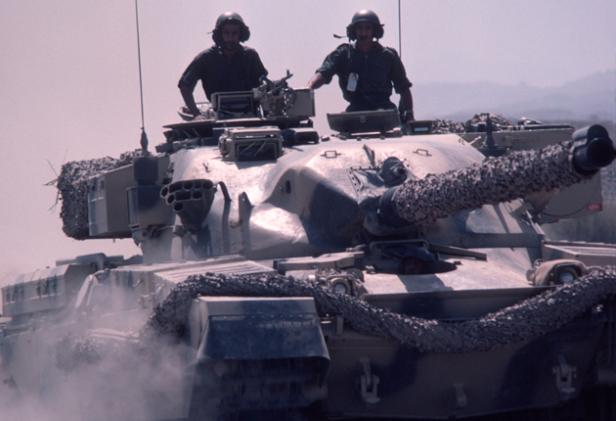
In January 1981, after the Iraqi offensive had run out of thrust the Iranians launched a counterattack at a place called Susangerd.  The Iranians brought about 400 Chieftains to bear on a slightly smaller Iraqi force.  The Iranians lacked reconnaissance and artillery support.

Before the battle could be joined Iranian engineers began to construct bridges over the Karkheh River.  Without screening reconnaissance forces the Iraqi's could calmly watch and report.  Realising that a major offensive was planned the Iraqi force fell back two kilometres and took up defensive positions, also digging in on the flanks to create a perfect kill zone.
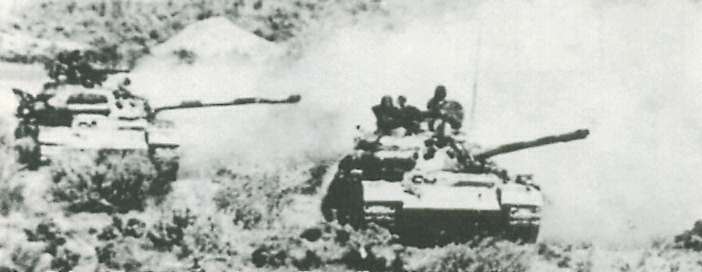
The area itself was the flood plain for the river, and was extremely boggy and wet.  Only two paved roads ran across the area. The lead Iranian Brigade attacked along these roads in column, with no scouts to screen them.
When the Iraqi's opened fire from their hull down positions they had perfect flank shots negating the huge advantage of the Chieftains frontal armour.  Equally when the Chieftains tried to manoeuvre they bogged down and became immobilised with frightening ease due to the poor power output and unreliability of the engine. The entire lead brigade was wiped out.
Frontal penetrating hits on Iranian Chieftains
The next day the Iranians launched their second brigade into the fight.  Through sheer brute force they managed to close with the Iraqi's.  The Iraqi's inexperience began to show, instead of out manoeuvring the Iranians they just held on and a brutal close range fight developed.  At such close range the massive fire-power of the Chieftains could smash through even the best armour of the Soviet tanks.
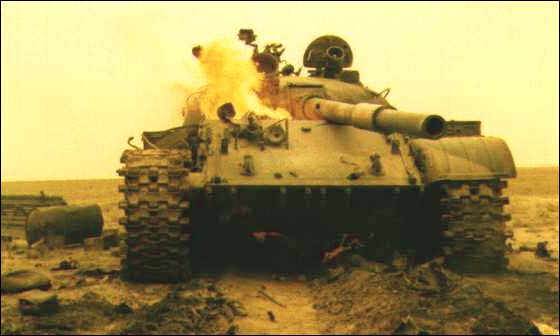
It was all for nought as the Iranian Chieftains took too much of a beating and they had to fall back.  After the battle one hundred Iranian tanks had been destroyed and a similar number were captured. The Iraqi's had lost about fifty tanks and fifty more smaller armoured vehicles.

This costly failure did combat test one part of the Chieftain that passed with flying colours, Crew survivability.  All the bag charges in the Chieftain were contained in a special storage container filled with a Glycol and water mixture. This often managed to retard the rate at which the bag charges burned when a tank was penetrated.  When a container was pierced there would be a white smoke and a loud hissing noise giving warning that a fire had started. Although eventually the fire would spread this would often take several minutes,  more than long enough to evacuate wounded crew members.  In comparison a Soviet tank on the Iraqi side would often be torn apart immediately by its ammunition exploding if it was penetrated.
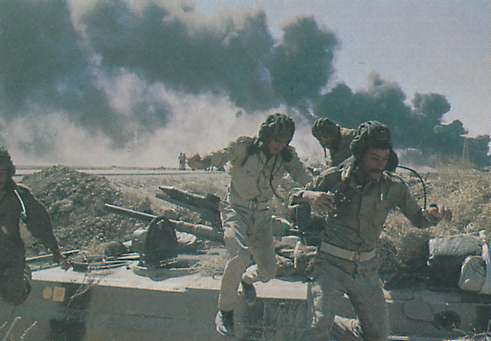
Iraqi's bailing out of a BMP1
The frontal armour also worked.  Later in the war at a border check post called Zeid, an Iranian tank commander was hull down as the Iraqi's attacked.  Whilst he was using the periscope to direct his gunner towards one of the attacking Iraqi T-72's he suddenly couldn't see.  Sticking his head out of the hatch he saw a glowing spot on the turret front.  An Iraqi 125mm APDS (Armour Piercing Discarding Sabot) round had passed through the crest of the sand bank in front of his tank and impacted on his armour without penetrating.

Part two can be found here.

Edit 10/2/14:
Made a mistake with the dates, and I, rightly, got called up on it. The error is fixed now.

Thursday, February 6, 2014

[WoTB] German Tech Tree

Initial German tech tree for World of Tanks Blitz revealed.


This makes it. All researchable tanks for Blitz have been announced by now. US and USSR

Wednesday, February 5, 2014

Let's Battle Magazine

Wargaming's Let's Battle magazine is now available for your mobile.


Check it out on iOS and Android.

Your feedback is appreciated.

Monday, February 3, 2014

[WoT360] Moar Tanks!!

World of Tanks 360 for Xbox 360 is now live! Not yet worldwide (this is to come).


Sunday, February 2, 2014

Libya's Death Star

On the morning of the 19th of March 1987, the sun began to flood the desert around Bir Kora in northern Chad.  It revealed a parched desolate landscape with no vegetation at all, just reddened or ochre rocks.
It also revealed a Libyan tank battalion resting in Laager.  The Libyans had set out the day before from the fortified camp at Wadi Doum with the mission of retaking the town of Fada.  The Libyans hadn't deployed any scouts overnight, and little did they know the Chadian forces had found them and surrounded them.
Libyan Camp, photographed by French air force in 1986
Fada had fallen to the Chadian forces a couple of months previously.  The planned recapture of Fada was the latest in a series of battles fought between Libya and Chad over the previous 9 years.
Libyan forces had copied the Warsaw Pact doctrine, and purchased all the Soviets latest equipment with oil money.
Set against that you had the fierce, wiry desert tribesmen who were almost untrained. As an example the Chadian armies Special Forces received only six weeks of training.
The Libyan forces had set up a base at Wadi Doum.  The base was heavily fortified around a long runway, which ran between two hills.  On the top of those hills was a Soviet “Spoon Rest” radar system which controlled an entire SA-6 surface to air missile battery.  Over 5000 men were defending this complex loitering in the emptiness of the desert. One US intelligence official described it as equivalent of the Death Star from Star Wars.
French Air force photograph of an SA-6 at Wadi Doum
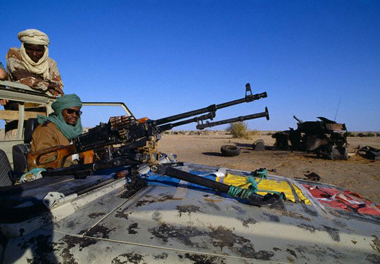
About 400m from the Libyan T55's lay a rocky hill with its sides covered by sand.  Hidden at the top of the hill was a Toyota pickup truck.  The Chadian soldier in the back was one of the few with a degree of training, as his Toyota mounted one of the latest French supplied weapons, a Milan guided anti-tank missile.
On a signal from their commander the Milan gunners launched a volley at the Libyan tanks.  Some missiles hit and some missed.  When they did hit the missiles easily punched through the tanks armour, often causing the turret to blow off.  The Libyans began to return fire although their rounds had little effect, as they were trying to hit a man sized target at 400m. Their shells peppered and blasted the rocks the Chadians were using as cover.
The Libyan commander ordered most of his forces to shift over to face the direction of the incoming fire.
As they did so the Chadians launched their real attack.  More Toyotas charged towards the weakened Libyan rear flank.  The few tanks left to defend it desperately tried to track their guns round onto the Toyota pickups which were moving at over 70mph across the fine sand.  Some of the T55's managed to get their guns on target, and even a near miss would smash the speeding pickup.  Unfortunately the Libyan numbers were too few to prevent the attack from breaking through the line.
The Libyans tried to shift some of their tanks back to face the threat, but they quickly bogged down in the fine talcum powder like sand.  Rampaging around inside the Laager the Chadians began to engage the Libyans with small arms, LAW’s (Light Anti-Tank Weapon) and RPG’s (Rocket Propelled Grenade).  Some were launched at such close range that the rockets would strike the tanks and the explosion would kill the firer.
The Libyan commander panicked and radioed to Wadi Doum for help, but before the relief force could set out the battle was over with a crushing victory to the Chadians. A few Libyans managed to flee back down the road towards Wadi Doum.

The tactics the Chadians had used were identical to ones the desert tribes had been using for centuries only replacing horses and camels with Toyotas.  Yosko Hassan, Assistant Commander for the force said to reporters later:
"We Chadians, we had nearly nothing. Our army is a young one, with very little means. We tried to act within our means."
 The fleeing Libyans met the relief column 12 miles back up the track, and the relief force took up a similar position overnight with a battery of six 122mm artillery guns.  Further up the track were a number of tanks. On the morning of the 20th the Chadians repeated their attack in almost exactly the same way.  This time the rout was even more pronounced. The Libyans fled with almost no fighting with the artillery not even firing a shot, and eleven T55's were abandoned where they sat, the keys still in the ignition.
The panicked fleeing troops reached Wadi Doum air base, and warned the defenders that the Chadian army was on the way.  The defenders ignored the dire warnings and continued with their daily routine. Some tended the small irrigated gardens which were the only green plants for hundreds of miles.  Others made plaques with passages from Qaddafi's green book or the Koran.  The words were made by gluing stones and pebbles to boards.
They defenders thought they were safe inside two rings of defensive lines and minefields. The approaching dust clouds were thought by some to be their missing troops returning. On the 22nd the Chadians attacked, quickly overwhelming the outer defensive line.
Wadi Doum under French Air attack in 1986
Knowing about the minefields some Chadian soldiers thought their Toyota's could skip right past the explosions unharmed, about 12 Toyotas tried this but were quickly destroyed.  The rest of the Toyotas formed up and charged down the road into the main gate.
The Libyans panicked, and despite having overwhelming numbers and fire-power they fled with no attempt at a coordinated fight.  The Chadians rampaged through the camp, occasionally pockets of resistance would be found and quickly destroyed by the Toyota borne Chadian army.  Within an hour the runway had been captured, and by the early evening the rest of the base was also captured.
Searching the base the Chadian army found massive quantities of weapons.  There were underground storage facilities holding weapons and ammunition, one had twelve brand new unused T2 tanks.  Outside in the vehicle park were the West German Faun tank transporters that had brought them to this base. Numerous aircraft were captured undamaged as well, although the assault had burned some out.  The prize was the full Soviet SA-6 battery, of a new type not known about by NATO.  After French requests the battery was transported to the south and well out of range of Libyan retaliation.
The Libyans began bombing the base in an attempt to destroy some of the $1 Billion worth of equipment captured by the Chadians.  One L39 Albatross flew to low and was shot down by a Stinger missile.  From then on the Libyans flew at high altitude, and although the Chadians fired more Stingers the Libyans were well out of range.  From that high altitude though, the bombing was largely ineffective.

The Libyans had about 1300 soldiers killed, and 500 captured. The Libyan regional commander, Colonel Khalifa Hastar was also captured, and his deputy Colonel Gassim abu Nawar was killed in the assault.  The Libyans also lost hundreds of tanks, APC's and trucks.
The Chadians lost 29 killed and 58 wounded.

But there is more to the story.  The few Libyans that managed to flee the battle, ran to the next Libyan fortification at the town of Faya-Largeau.  This was the home town of the Chadian President.
Some Libyans ran into their own minefields and were stranded and unable to move.  They were captured along with the city by the Chadian army on the 27th.
The forces of Chad didn't need to fire a single shot, as the Libyans ran before they arrived.

This part of the Chadian-Libyan conflict became known as the Toyota War, for obvious reasons.

Saturday, February 1, 2014

[WoTB] World of Tanks Blitz: Tanks and Tablets

Popularity of the original World of Tanks did not leave aspiring game development studios indifferent. Since 2011 WoT-resembling (in terms of gameplay) products started to rocket on different platforms including mobile - smartphones and tablets. Naturally Wargaming.net is not going to disappoint their customers and is going to come up with their decent version of tanks for tablets.
Developing games for iOS and Android platforms is a very special case that requires very dedicated and focused professionals. Wargaming didn't have that kind of expertise until recently.

DAVA, a Belarusian development studio, was founded in March, 2008 in Minsk. The guys chose their specialization right away. They decided they would be developing apps for iOS. The date of founding the studio is close to the date of App Store creation (July 10, 2008). So, we may say that DAVA is a peer of the most popular iOS apps store.
While others were examining the newly appeared service, the young studio was already developing products for it and was among the pioneers on the newly-formed market.
DAVA had for co-founders: Andrew Karpiuk, Vitaly Borodovsky, Dmitry Bobrovnichiy, and Alexander Fomenko; as well as six key soldiers: Ivan Petrochenko, Alexey Prosin, Stepan Drozd, Kirill Poliakov, Victor Kleschenko, and Alexey Alexeev. This were the “bones” of the young development studio. Nobody in Belarus had developed anything for iOS befor DAVA was founded. And obviously WoT Blitz is not the first product the team has worked on. They had produced quite a few games and apps (with over 10 mln downloads and over a million purchases) before they started working on WoT Blitz. The team used to work as a subcontractor for Electronic Arts, iWin, Freeverse, and other publishers. The audience of DAVA own product users is about 9 million with a lot of apps and games to appear among TOP100 in free and grossing charts.

Some of the DAVA products include:

Modern Weapons: Small Arms (encyclopedia)


Jewel Quest Mysteries


Space Storm


Wargaming has been in touch with DAVA for quite some time. There even were a few ex-Wargamers working for DAVA. The acquisition finally took place in 2011. The first major game project - World of Tanks Blitz - was started in spring 2012 (first prototype) and officially greenlit in December 2012.

The mobile department of Wargaming currently consists of 3 independent teams:
-       The WoT Blitz team distributed in Minsk and a few Ukrainian cities.
-    Framework team (cross-platorm game engine development)
-       The Service Apps team developing apps assistants World of Tanks and World of Warplanes

Vitaly Borodovsky - tech director
UX/UI design in progress
Designing maps for Blitz
GD is thinking over a new feature - agile board in the background
As for the game, WoT Blitz, it has been demoed at multiple gaming shows throughout 2013 and early 2014, including public gaming areas during G-Star 2013 in Korea and Taipei Game Show 2014, which means that the game in nearing closed beta with iOS release scheduled for first half of 2014.

A couple of new screenies below.

The map is called "Mines". Should be recognizable 

From another perspective with HUD

Another map - Copperfield

Tuesday, January 28, 2014

[WoT] 0.8.11 is Coming

How do you like the upcoming 0.8.11 update for World of Tanks?

Any major concerns or ideas?

WT E100 will lose 200HP btw. 

Sunday, January 26, 2014

Erfolgreiche Flucht!

On September the 5th, 1940, a ME109 was in a dive over England, with a Spitfire behind it. The ME109 pilots name was Franz Von Werra, and things were going badly. Just a week earlier he had returned from a sortie and claimed 9 RAF kills in that single mission, even though he hadn't a shred of proof. He'd been lauded across the German press for this feat. The fame had been welcome for Von Werra, who had been born in Switzerland to an impoverished noble family. Now he was about to start a true adventure which would rightfully make him famous, not the imaginary one which he had relied upon until then.

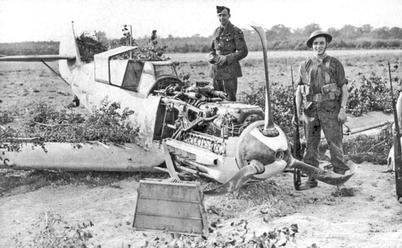
Escorting a bombing raid against Croydon, Von Werra had seen RAF fighters attack the bombers, and following the lead of his squadron commander they had prepared to dive on the RAF. As they committed themselves another flight of RAF Spitfires bounced them. In the ensuing dogfight Von Werra's ME109 had its engine damaged (some sources claim by frenziedly fire). As he dove away one of the spitfires latched onto his tail and followed him down pumping bursts into his stricken plane. As he roared over searchlight detachment the British soldiers had joined in firing Lewis guns at the ME109. Von Werra arrived in England, unhurt, only a few fields later, near a place called Loves Farm.

Von Werra's ME109
He was quickly taken prisoner by local farm workers and the cook from the Searchlight detachment, and was handed into the police force and then the army. He joined the rapidly growing umber of German airmen who were POW's of the British. During interrogation the British checked the details of Von Werra's story, and found the 9 kills to be false. The BBC made great work of the propaganda victory. However in an oddity of life, the Germans hearing the denunciations against Von Werra's tally thought it must be true and so he was credited with all the kills, this action got Von Werra awarded the knights Cross.


Meanwhile in the UK Von Werra was now at Camp No1 near Grizedale Hall in the Lake District. Where he hatched the first of many escape plans. The POW's were exercised outside the camp each day, and at the same point in the route the excursion party would pause to allow the POW's to rest. Von Werra proposed to simply slip over the wall at that location and escape. With the support of the camp he started making plans. First the senior German officer in the camp asked the British to change the time of the exercise period. With the excuse it was interfering with the German's educational activities the walk was dropped from the morning to the mid afternoon. This would mean Von Werra would only have to avoid capture for a few hours before night. Secondly a German was appointed to cause a small distraction amongst the guards.

On Monday the 7th of October the plan was put into action. The roads in the area were utterly deserted, but as fate would have it a Greengrocer's cart was approaching the corner when the Germans arrived.
The plan was put into action, as the German selected for the Decoy stepped out of line to talk to the British NCO leading the party, he was immediately yelled at and told to return to his place. Von Werra's plan was failing, as he didn't have distraction, and soon they'd move off again. Then the cart and horse passed by, and Von Werra spotted it would block the British guards line of sight to him and at the right moment he rolled over the stone wall. Lying in the shade of the wall he waited for yells from the guards. None came, eventually the party moved off with him unmissed! He was free!

Von Werra was however free in in the Lake District in Autumn. Three nights later he was sheltering in a small stone shed on the hills when two Shepard's in the Home Guard found him. As he was led away in captivity Von Werra suddenly threw his weight about and knocked the two men over and took off into the darkness. He easily outdistanced the two old Home Guards. With a rough location the net tightened, and eventually on the night of the 12th Von Werra was recaptured by a search party whom had just retired for the night to the local pub. When one man saw a lone figure in the distance, the party turned out and combed the area. Eventually Von Werra was found lying almost totally submerged in some mud.

After a period in solitary confinement Von Werra was transferred to a new camp, Hayes Camp, in Swanwick, Derbyshire. Here he worked with a number of other prisoners to dig an escape tunnel. On the 20th of December Von Werra and his fellow escapee's broke out. A diversion was provided by Germans singing loudly. The song they chose was a German folk song "Muss I denn, muss I denn, zum Stadtele hinaus", which translates as "I must away into the great wide world".
The next morning wearing his Luftwaffe flying uniform he claimed to be a Dutch pilot whose bomber had been shot down at a local railway station. Eventually through guile he managed to convince the station staff of his identity. After a phone call a car was dispatched from the local airbase, RAF Hucknall, to pick up Von Werra. When he arrived on the base he was questioned by a very suspicious squadron leader. While the Squadron leader attempted to contact Von Werra's invented unit and airbase, Von Werra excused himself to visit the toilet. Once out of sight he made a break for it, looking for a plane to steal and fly back to Germany! As luck would have it he climbed over a security fence and ended up in a Rolls Royce factory. A group of civilian mechanics approached and assumed he was an Air Transport Auxiliary pilot here to ferry a fighter plane to a front line unit. So after getting him to sign into the visitors book he selected a fighter.

But the engine wouldn't start. The mechanics went away to find a starter trolley to get the Merlin engine to turn over, while Von Werra sat in the cockpit, head down, familiarising himself with the controls. When he looked up he saw the squadron leader with a revolver aimed firmly at his face.
In January 1941 Von Werra was moved to another camp. This one was quite a bit further away, in Canada. The British assumed it would be extremely difficult for a German POW to escape across the Atlantic.
The Germans were shipped safely with a large escort, and when they had been disembarked they were placed upon a train. Each carriage had a couple of guards in it, but was otherwise a normal carriage. As the train moved across the Canadian countryside Von Werra worked at freeing the window he was sitting next to. It had been iced up by the harsh Canadian winter. Eventually he had it free, and at an opportune moment he signalled one of his fellow Germans, who stood up and started to fold his coat, blocking the guards view. At which point Von Werra went out the window of the moving train. After trudging through the snow he came to a river, which was partially iced up. The centre of the river was still flowing water. To get wet would have been deadly. Luckily Von Werra managed to find and steal a rowing boat and so crossed into the United states. Which at that time was still neutral.

Von Werra turned himself into the US police and was charged with entering the United States illegally. He contacted the German consul in the US, and while the Federal government was deciding what to do with his case, Von Werra had been smuggled out of the country, and through several other neutral countries until he returned to Germany.
Publicity photograph taken by the Germans of Von Werra and his pet Lion cub Simba
For his exploits he was awarded the Iron Cross. Von Werra was also asked to inspect the German POW arrangements for the British. He said upon viewing the conditions "Better to have been captured by the British than the Germans!". It was his comments that lead to the massive improvement in POW conditions for Western allies.
Von Werra returned to flying, and was lost over the North sea to mechanical failure on a training flight.

Wednesday, January 22, 2014

[WoT] Nation vs Nation

Well, guess, you've heard that. What do you think of the idea - having factional battles in World of Tanks (and may be some other our games). For now, as a part of random battles - USSRvsGermanyvsUSvs...

Will this give us a definitive answer: are the devs biased or not and which tanks are the best? :)

Sunday, January 19, 2014

The Secret Service Yacht Club

From today Scott Wichall has volunteered his time free of charge for the daunting task of proof reader for these articles. So my Thanks to him.

On 4th of January, 1890, a plantation owner in Sri Lanka called John Agar was celebrating the birth of his 13th child.
The new born son was called Augustus Agar, and he would grow up to be one of the Royal Navy’s notable officers. Augustus' mother died shortly after he was born. Augustus was sent away to boarding school in Britain, but at the age of 12 his father died whilst he was in the UK. Now orphaned Augustus and his elder brother decided he should join the Royal Navy.  Sponsored by a friend of the family Augustus joined the Royal Navy in 1904, and was sent as a cadet to an old wooden Man-of-war which was being used as a training ship.
His first taste of action was on a Pre-Dreadnought supporting the Gallipoli landings. After the failure of that campaign Agar's ship was back in the UK. None of the Royal Navy’s Pre-Dreadnoughts were ordered to join the grand fleet for the battle of Jutland, so Agar had to watch as the Fleet steamed out of harbour without him. He was then transferred to another Pre-Dreadnought cruiser as the Executive Officer. This cruiser was stationed in Murmansk to keep the sea lanes to Russia open. He arrived there in March 1917, as the Russian Revolution swung into life.
HMS Hibernia, Agar's ship during the Gallipoli landings
HMS Iphigenia, Agar's ship at Murmansk
A Russian protected cruiser called Askold was based at Murmansk.  Agar had served alongside her against the Turks and knew several of the officers. When the Ship was grasped by mutiny and the officers arrested he could do nothing to help. Equally he could see the supplies being delivered by the British were being used by the Bolsheviks as well. At the start of 1918 the Royal Navy withdrew from the Russian ports, and Agar transferred to Coastal Motor Boats (CMB's).

 These were small 40 foot plywood shells, resembling a canoe. The CMB had a hydroplane and an aircraft engine to power it, due to this they could reach speeds of 45 knots. Each craft had three "cockpits" for the three man crew. Although they often had a Lewis gun fitted to them, the main armament was a single torpedo in a trough at the back of the boat. The torpedo was shoved out of its trough, tail first, by a cordite charge. The CMB then had to turn hard and fast to avoid being hit by its own torpedo.  Agar served in these boats until the end of the war, even taking part in the Raid on Zeebrugge.
The end of the war found Agar and the CMB's at Osea in Essex, with nothing in the immediate future. Agar had by now reached the rank of Lieutenant.

The Secret Service approached Lt Agar. Their problem was a British spy, a master of disguise, was in Bolshevik controlled Russia. Although the Bolshevik secret police, the Cheka, were looking for him they couldn't catch him. They had however caught seven of his couriers who had been carrying vital intelligence. Each courier had died in a messy and unpleasant manner. The British Secret Service wanted Agar to take a pair of CMB's to the deserted yacht club at Terijoki on the gulf of Finland to act as transport for couriers, and later in the year pick up their spy. The CMB's would theoretically be entirely under the control of the Secret Service. The mission was considered extremely hazardous, and only unmarried volunteers were called for. The crews of the CMB's would wear plain clothes, although they did have Royal Navy uniforms on board in case of capture. This was a futile gesture considering the situation. Lt Agar agreed and set about preparing his crews and two boats CMB4 and CMB7.

When the crews and boats were shipped through Sweden, Swedish Customs started asking searching questions. As the crews were in plain clothes, they claimed the boats were the latest type of pleasure boat, and the crews were salesmen. It's a very good thing the Customs officials didn't open the boxes listed as spare parts, as those contained the Royal Navy uniforms and Lewis guns. It should be noted that the CMB's were not going to carry torpedoes although the launching gear was stored with the Lewis guns.
There is a line of forts protecting the Russian base of Kronstadt. On June the 15th 1919, shortly after Lt Agar had arrived there were plans by the forces in them to revolt against the Bolsheviks. These have often been referred to as White Russians, but this was not the case. The area had its own identity, the Ingermanlanders wanted nothing more than independence, like Estonia and the other countries in the region had gained from Russia. The forts, and some local forces were drawing up plans to mutiny and try to seize their chance. However the Commander of the fort Krasnaya Gorka came under suspicion, and a Commissar arrived to detain him. With no other choice the fort rebelled. The early rebellion destroyed any chance of a coordinated uprising, and ended the Ingermanlanders dreams of independence.
The Bolsheviks were quick to respond, dispatching a pair of battleships to bombard the fort. After an initial savage beating the bombardment had tailed off towards the end of morning. The barrage recommenced about 1100.

11 Miles away at Terijoki, Lt Agar and several others were watching these goings on from the church above their base. Knowing the Estonian army were forming an attack plan to help the forts Lt Agar wondered if blowing the destroyers up might give the forts defenders a breathing space, allowing the Estonians to launch their attack. After Lt Agar had travelled to see the Royal Navy’s Baltic Fleet and spoken to its Commander, he was given a pair of torpedoes.
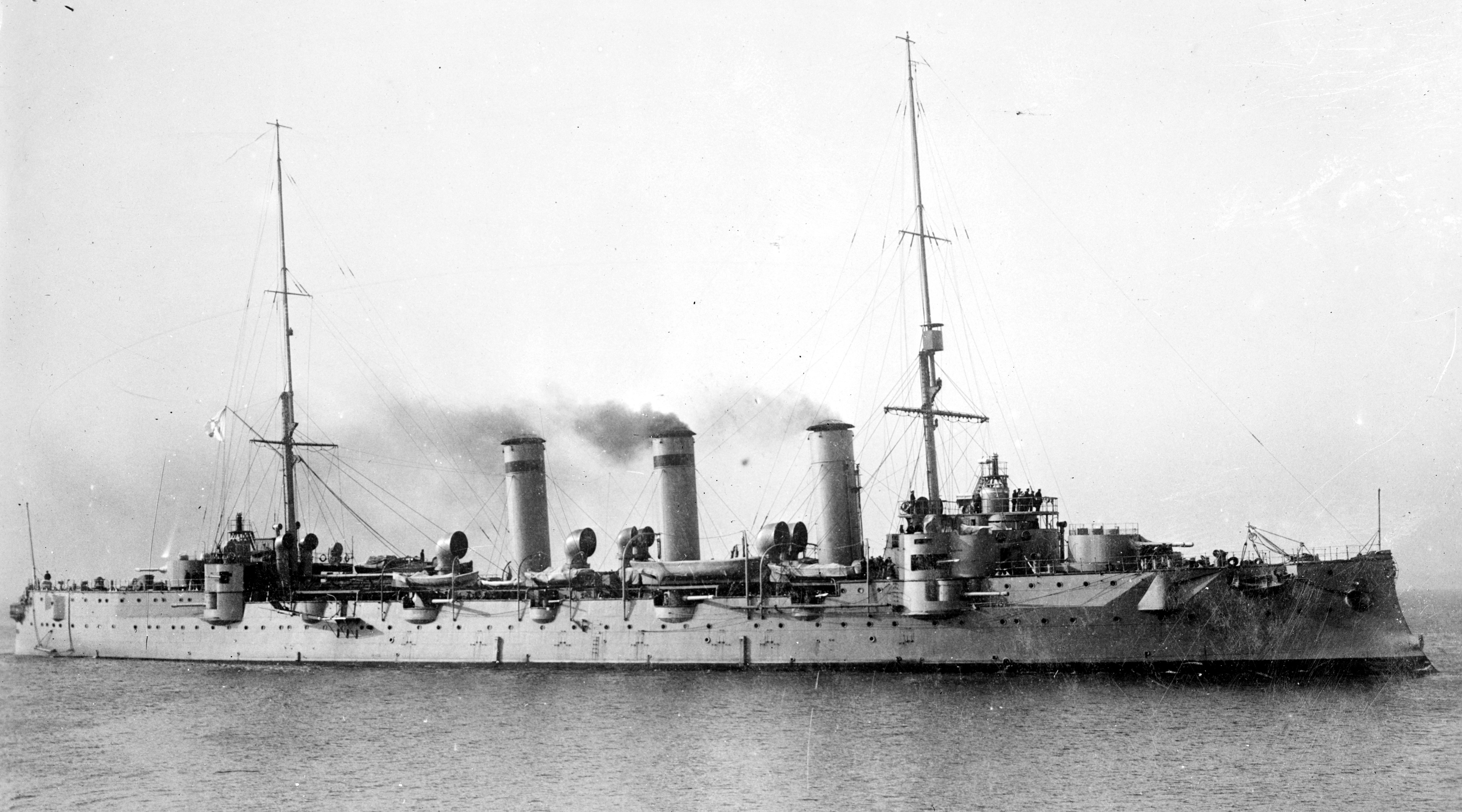
Russian Cruiser Oleg
On the morning of the 16th Lt Agar was once again on the Church tower. The two battleships had retired to Kronstadt but the heavy cruiser Oleg had taken their place. That night he decided to carry out his mission. Both CMB7 and CMB4 set out just after midnight. Due to their northern position, darkness at that time of year was only a few hours long. Shortly after setting out CMB7 hit a submerged object and sheared its propeller and rudder off. CMB4 towed the stricken boat back to harbour but by the time it was secured it was 0400 and the short night was over.


The following night the Oleg was still in position, so Lt Agar set out with the two other men of CMB4 to destroy the cruiser. A line of destroyers had formed a picket to protect the Oleg, Lt Agar swung round the extreme end of the picket line. As he was preparing to launch his attack disaster struck, Sub-Lieutenant Hampsheir stumbled and fired the cordite charge that launched the torpedo. Luckily, however, the torpedo was still tied down for travel, so it failed to launch. It bucked and strained at its bindings as the engine raced. Chief Officer Beeley quickly tackled the torpedo and brought it back under control. Chief Officer Beeley also repaired the firing mechanism with nothing more than a pair of pliers.

The damage had been done though as someone had heard the cordite charge going off, and searchlights began to sweep the area. As they probed closer Lt Agar brought CMB4 to a halt so the glowing white wake wouldn't give their position away. There they drifted while the others attempted to re-arm and re-prime the torpedo as the search lights drew nearer to them. Less than a mile away to the North lay the first destroyer of the picket line. About the same distance away to the south was the Bolshevik coast and its forts.
After about 5 minutes Sub Officer Beeley gave Lt Agar the thumbs up. Peering into the darkness Lt Agar could just about make out the cliff like side of the Oleg, ramming on full throttle he aimed CMB4 right down its throat.

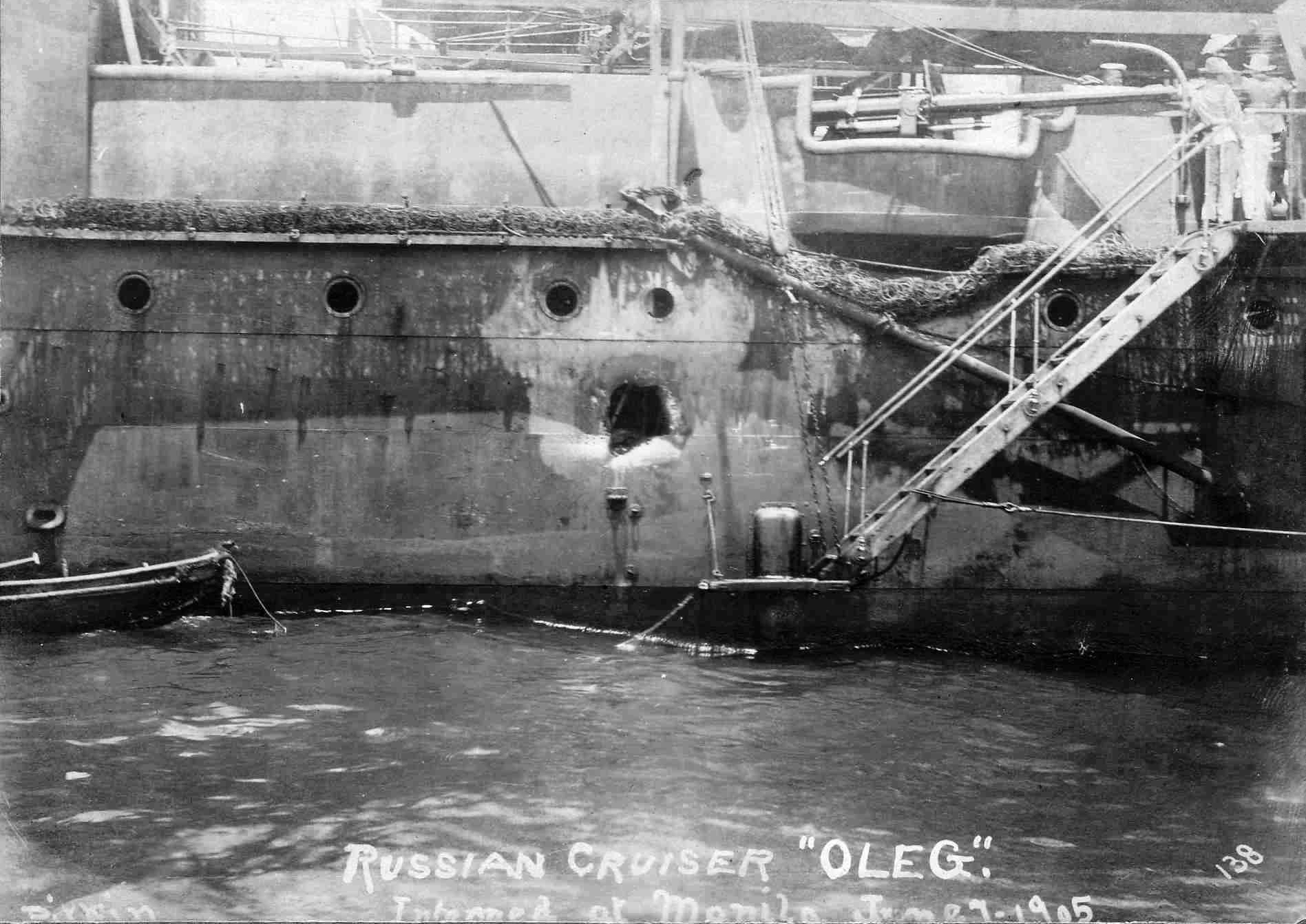
Oleg, after suffering damage against the Japanese in 1905
At Lt Agar's signal the torpedo charge was fired for a second time, this time the torpedo launched without a hitch. By now the wake of CMB4 had been spotted and as Lt Agar swung round in a huge turn at full speed everything the Bolsheviks could bring to bear was fired at them. Tracer fire from machine guns sleeted past, explosions from HE shells showered the boat. Throwing the wheel left and right to throw the gunners aim off CMB4 drew a brilliant line through the water, Lt Agar swerved through the picket line charging between the destroyers who were closing in on him, and neither was more than 200 meters away.

Then a huge explosion lights the night behind CMB4, the Oleg is illuminated, and a huge black cloud is blown out of the smoke stacks. When they arrive at Terijoki CMB4's crew are met by several people who were watching from the Church tower. It looks like the Oleg had been hit in the magazine and had sunk! That the Oleg had been sent to the bottom was confirmed the next day by an aircraft flying over the location of the ship.
That aircraft might also have seen the force of Bolshevik sailors assaulting the fortress of Krasnaya Gorka through the holes torn in its wall by the bombardment. Despite getting over run the defenders were able to use escape tunnels to retreat to Estonia.

CMB4 towed the damaged CMB7 to the RN Baltic fleet for repairs, as they entered the anchorage the decks of the ships were filled with cheering sailors. The crew of one destroyer held up a hand painted sign with the words "Giant Killers!" written on it.

Lt Agar turned to Beeley and said "So much for secrecy."

Lt Agar won the Victoria Cross for his actions, Sub Officer Beeley the Conspicuous Gallantry Medal and Sub-Lt Hampsheir a Distinguished Service Cross. CMB4 is currently on display at the Imperial War Museum Duxford.