Purpose of this blog

Dmitry Yudo aka Overlord, jack of all trades
David Lister aka Listy, Freelancer and Volunteer

Thursday, August 29, 2013

[WoT] News From the Front

Related to 0.8.8:

  • Superpershing's armour "belt" on upper armour plate is now 2 times wider (hitbox now corresponds to the visuals)
  • E-75's passing ability for bad and medium terrains is improved
  • Ammo sliders have been reversed to previous version. Will be improving the new version.
  • Bugs and glitches related to going into battle have been fixed. Now it should work ok.
  • There will be a surprise related to global rating.
  • British desert camo with blue string will be returned.

Not related to 0.8.8:

  • Haven't decided on KV-1S top gun thing yet. This is being discussed.
  • Object 140 turret will be re-armoured (going to be similar to T-62A) some time in 0.9.0 - need more tests.
  • The concept of historical battles is now more or less finalised and almost ready to go into pre-production. Finally.

[WoWP] Prem Account Giveaway

With the release of 0.5.2 update for World of Warplanes open beta.

Now you can earn tokens in WoWP and use them to purchase unified/single premium account for both WG games currently being available - i.e. "free" WoT prem accounts are now available.

It's farming time!


PS: EU guys, sorry for the communication issue and absence of proper announcement on what was going to happen with tokens. 

Tuesday, August 27, 2013

[WoTB] New Screenshots

World of Tanks Blitz is now being tested internally. The game was demoed behind closed doors at Gamescom. At this stage we are satisfied with what we have got - closed beta will show though.

Below are some new screenshots (yes, they are not from PC):


Sunday, August 25, 2013

From the Darkness, Light!

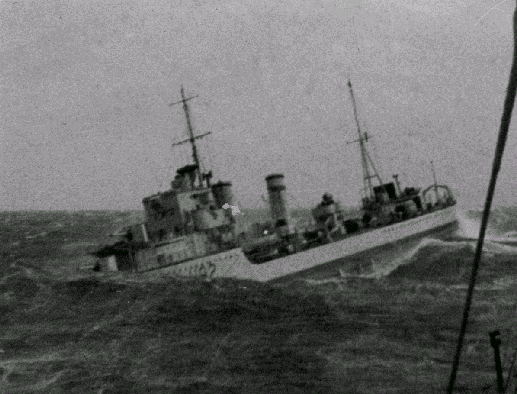
“From the darkness, light” was the motto of a G-class destroyer that was commissioned into the Royal Navy service on 22nd of January 1936. It would meet its fate in the cold waters off Norway 4 years later, fighting what has to be one of the most out matched battles in the Royal Navies history. During which its captain won the first Victoria Cross of the Second World War. The ships name was HMS Glowworm, a name I suspect many of you will already heard of, if not the exact details of the fight.


Glowworm had a bumpy career being involved in two collisions, the first in 1939 was with her sister ship HMS Grenade, the second was with a Swedish ship Rex in 1940. After repairs Glowworm set out on her final mission escorting HMS Renown. This battlecruiser was the core of a small force sent to screen mine laying operations off Norway to prevent the German invasion of April 1940.

On the 6th of April a crewman at one of Glowworms torpedo launchers was washed overboard in very heavy seas. The ship’s captain Lieutenant Commander Roope was well liked, and respected by his ships company, so it’s not surprising he requested permission to detach from the task force to search for the seaman. Renown gave the go ahead despite there being no chance at all to find the missing crewman.


Glowworm started a search which lasted about two hours and found no sign. During the search the ship had taken such a battering some of its navigating equipment had been damaged which made it hard to find and re-join Renown.

On the morning of the 8th Glowworm was still separated from the task force, when she saw another destroyer through thick fog at about 0800. Hailing the destroyer Glowworm asked for identification as the ship wasn't flying an ensign. Luckily it responded, and identified itself as Swedish, then opened fire! The ship was actually a German destroyer carrying troops to Norway. Glowworm responded, and is said to have caused quite some damage. Before too long another German destroyer appeared and joined in the attack on Glowworm.
Suddenly both ships broke off and ran for the cover of a rain squall. LTC Roope had a suspicion he was being lured towards a larger force, however he knew that the information of where the Germans were would be invaluable to the Royal Navy, so he pursued.

As Glowworm emerged from the squall the huge bulk of the battlecruiser Admiral Hipper loomed into view. At first the Admiral Hipper had trouble telling the destroyers apart, however after a few moments she worked out which ship was the enemy and opened fire. Knowing he couldn't disengage, LTC Roope knew he had one chance. On his deck he had 10 Torpedo tubes. Glowworm signalled the information to Renown, and blowing smoke to provide herself with cover she turned to attack.

 The smoke had no effect. The Admiral Hipper had radar controlled main guns and continued to hurl shell after shell at the British destroyer. Glowworm took several punishing hits, but closed the range. Admiral Hippers guns were designed to take on armoured cruisers such as herself. She weighed 14000 tons, and wore 3 inches of armour. Glowworm in contrast weighed in at just under 1500 tons, had no armour and had four 4.7 inch guns which couldn't go through the German cruisers armour. So you can only imagine the damage that those 8 inch shells did.
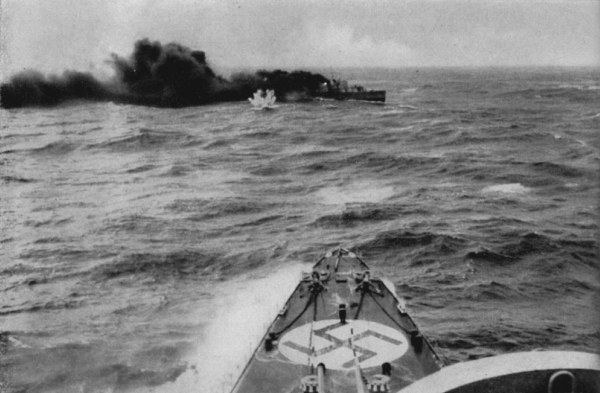

Glowworm makes her first torpedo attack
Glowworm emerged from the smoke a mere 900 yards from the Admiral Hipper, at that range the German cruisers secondary armament engaged scoring several hits and felling Glowworms mast. This caused her siren to start shrieking. The high pitched shriek carried on for the rest of the battle. Glowworm launched her first spread of 5 torpedoes. All missed, some by mere feet. LTC Roope returned to the smoke screen to try and repair the second launcher.
Admiral Hipper didn't give the battered destroyer a chance. She came crashing through the smoke screen in pursuit. In the swirling fight that followed Glowworm managed to launch a second spread of torpedoes, which also missed. As Glowworm exited the smoke screen she saw Admiral Hipper parallel to her.

Things become confused at this point with conflicting accounts.

LTC Roope in some accounts is heard say "Stand by to ram!", what is known is the Glowworm, still shrieking, with all guns blazing rammed into the side of the Admiral Hipper, Ripping a 40 meter gash in the side of the cruiser. Through which 500 tons of water poured. The impact destroyed the Admiral Hippers desalination plant and a torpedo launcher. The German ship took on a 4 degree list. As Glowworm reeled away with her bows smashed. She was pelted by gun fire from the Germans; even Small arms were being fired at the crippled Destroyer. In return Glowworms last 4.7 mount continued firing.
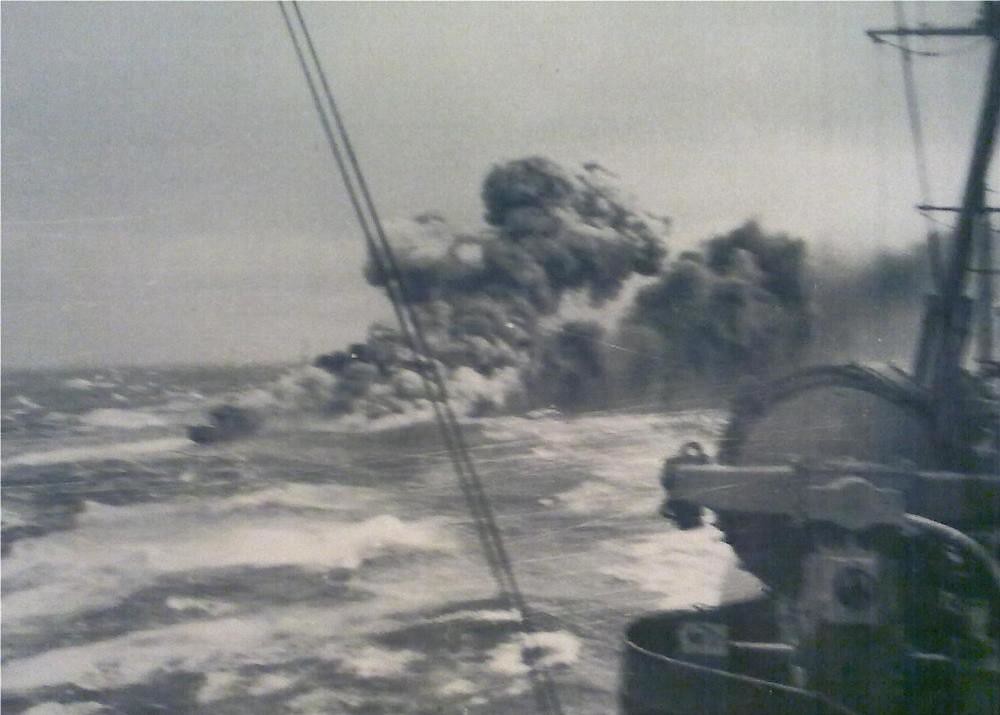
Glowworm just after ramming
With no more means chance of victory, and on fire and shipping water LTC Roope ordered abandon ship. After making sure the evacuation was in progress LTC Roope went below to open the seacocks to ensure the ship sank.

Glowworm sinking, one of the figures is reportedly LTC Roope
 Despite being laden with needed soldiers for Norway, and despite the risk to his vessel from Submarines Captain Heye halted the Admiral Hipper down current from the sinking Glowworm, and ordered all hands on deck to help rescue survivors. Shortly afterwards Glowworm sunk beneath the oil covered sea, as she descended her depth-charges detonated tearing the ship apart.

LTC Roope was seen helping survivors into life jackets and assisting his men to climb out of the sea onto the nets and ropes being thrown overboard by the Admiral Hipper. At last no further sailors could be seen, a rope was thrown to LTC Roope, who grabbed hold and was hauled towards the deck. Suddenly a huge wave crashed against the side of the ship, and LTC Roope, his strength failing was lost.


Admiral Hipper carried on with her mission and after returning to port after the invasion Captain Heye took the then unprecedented step of writing to the British authorities through the Red Cross recommending LTC Roope for a VC.

However with only half the story, and unable to confirm the events the VC wasn't issued until 1945 when the 36 surviving crew members from HMS Glowworm were repatriated at the end of the war.

Note:
One of the soldiers on-board Admiral Hipper had a camera, so all action photographs were taken during the battle.

This website has the detailed stories of three of the survivors.

[WoT] Testing 0.8.8

While we are slacking at Gamescom..


How is public test going? Is 0.8.8 big and good enough?

It's feedback time!

Monday, August 19, 2013

[ALL] WG at Gamescom: Direct Contact

If you happen to be in Cologne this week, don't miss your chance to step by Wargaming's booth at Gamescom (August 21-25).


It's a decent opportunity not only to grab some WoT/WoWP/WG-branded swag but also deliver your valuable feedback right into the face of developers, and of course learn more about our games - current and future ones.

Personally, I will also be available for chatting and beer-ing these days. Use comments to this post for communication.

See you around.

PS: And WoWP 0.5.1 is now live for EU and NA!

Sunday, August 18, 2013

Pirates of the Royal Navy

On the Evening of September 12th 1914 the German light cruiser SMS Hela was steaming near the island of Helgoland off the north German coast. Little did her captain know that the next morning there would be an encounter with one of the newest branches of the Royal Navy, and the aftermath of that encounter would create a new tradition.
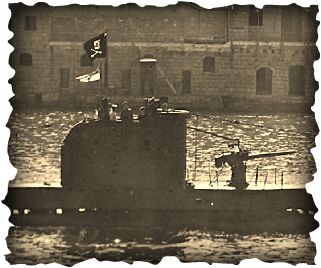
The next morning the Submarine HMS E9, commanded by Lieutenant Commander Horton, surfaced briefly, spotted the Hela and immediately submerged again. The Hela hadn't seen the Submarine, and when E9 was within 600 yards two torpedoes were fired. Both struck the Hela amidships and she began to take on water. 30 minutes after the Torpedoes hit Hela sunk, becoming the first ship sunk by a British submarine. Only two of the Hela's crew were lost. The Imperial German navy launched a furious hunt for E9, however despite searching all day despite this E9 evaded their detection. When entering Harwich harbour LTC Horton flew the Jolly Roger as a sign of his success.

SMS Hela
 
LTC Horton's choice of flag came from the words of Admiral Sir Arthur Wilson. Who had won a VC by launching a lone charge into hand to hand combat against Mahdist troops (fuzzy Wuzzy's) during the Sudan war. Admiral Wilson had decried Submarines as "Underhanded, Underwater and damned Un-English. Certainly no occupation for a gentleman!" He went on to say "We should treat all Submariners as Pirates in wartime, and hang the lot of them!”
 LTC Horton then went on to fly an extra Jolly Roger for each successful patrol E9 undertook, until he had room for no more flags. E9 spent allot of her patrols in the Baltic intercepting Swedish Iron ore shipments to Germany. He became such a thorn in the side of the German economy he was portrayed as a buccaneer, with the German press screaming headlines about "The underhand and criminal methods of the British Pirate Submarines!"


A red Jolly Roger was flown by the submarine HMS E12 as she operated in the Sea of Marmara, alongside HMS E11. I haven't been able to find out if E11 also flew that flag, but considering E11's exploits I don't think she needed to!
HMS E11 was commanded by LTC Nasmith. On the 18th of May, 1915, LTC Nasmith captured a Turkish vessel in the Aegean Sea. Tying his submarine to the captured vessel he sailed right past all the Turkish shore batteries, and into the Sea of Marmara. He set course for the Golden Horn (the area outside Constantinople harbour) immediately.
When he arrived he spied a Turkish heavy gunboat and fired two torpedoes at it. The first one missed and drew a huge circle forcing LTC Nasmith to have to dodge his own shot! The errant torpedo then hit a wharf detonating loudly. The second torpedo hit the Gunboat sinking it. Panic gripped the City, Traders started boarding up their shops, and people ran for home. Troops embarked on transports for the fighting at Gallipoli were ordered to disembark to defend the city.


E11 stayed on patrol for a further three weeks reaping a huge toll on the crowded sea. Many of LTC Nasmith’s kills were done by boarding ships and placing scuttling charges on the ship. E11 managed to keep its patrol up so long by its boarding parties stealing food from ships they boarded. LTC Nasmith also modified his torpedoes so they would stay afloat if they missed the target. Then the Commander would then swim out to the live torpedo, and disarm the warhead while swimming alongside it in the sea. The torpedo would then be returned to the submarine and refuelled for use later on.
After three weeks blockading Constantinople, Nasmith finally started to withdraw, heading back to the Dardanelles. On his way he learnt of a large coal transport heading for Constantinople. LTC Nasmith turned around and followed the transport. The huge haul of coal would have improved the cities position no end. Power supplies were sketchy, and morale was suffering. The coal shipment would have solved those issues. There was a huge crowd including local dignitaries waiting for the coal freighter. The crowd cheered when the freighter tied up alongside. Then LTC Nasmith's torpedo struck sending the ship and its cargo to the bottom of the harbour.
When LTC Nasmith returned he was awarded a VC for his patrol. 


E11 was refitted and fitted with a 12Pdr deck gun. LTC Nasmith took it for another patrol in the Sea of Marmara. Within hours of starting his patrol he surfaced alongside a coastal road, and put his new weapon to work shelling a column of Turkish troops marching to the Gallipoli fighting. Next he sunk the Turkish battleship Hayreddin Barbarossa off Bolayır with a single torpedo. 
His final act of daring was in collusion with First Lieutenant D'Oyly-Hughes. Creating a raft and filling it with explosive Lt D'Oyly-Hughes swam ashore and packed the charge into a culvert next to a railway viaduct. The viaduct had been shelled several times by E11, with little lasting effect. Lt D'Oyly-Hughes was chased back to the beach by Turkish ground forces, and despite being shot at managed to reach the safety of E11. When the charge blew it took out the entire viaduct.
E11's patrol lasted 47 days, a record not beaten in the Great War. During that time LTC Nasmith sunk 1 Battleship, 11 steamers, 5 Large sailing craft, 30 small sailing vessels and a number of Gunboats.


The last time the Jolly Roger was flown from a Royal Navy submarine was in 2011 when HMS Triumph returned to port after firing cruise missiles in Libya. However the last time it was flown for scoring a shipping kill was shortly after the USS Phoenix was sunk. The Phoenix, a survivor of the Japanese attack on Pearl Harbour, was sailing in the South Atlantic when she was struck and sunk by two Torpedos’. The British submarine that had fired them was HMS Conqueror, and the date was May 2nd, 1982. The USS Phoenix had been sold to Argentina and renamed the ARA General Belgranao. Interesting to note that the first (and only) kill by a Nuclear submarine was done with World War Two era torpedoes, as the captain of the Conqueror was unsure how well his modern torpedo would cope with the Phoenix's armoured hull.
When returning to base, as tradition allowed, the Conqueror decided to fly a specially made Jolly Roger. However there was nowhere to fly it from, so a broom was tied to the periscope and the flag flown from that, or so the story goes.

Wednesday, August 14, 2013

[WoT] ASAP 0.8.8

While this might be a bit late, adding the video on 0.8.8, to start talks on the major (as promised) upcoming update.

Among the big features:
  • Quest system improved and supported in the game client
  • New line of Soviet med tanks
  • National crew voices (finally)
  • Redesigned achievements/statistics tab
  • New map - Tundra
  • Komarin map is back!
  • Super Pershing rebalance (you will get a chance to sell it, if you want to)
  • and some more

Sunday, August 11, 2013

"Who's for the Guns!"

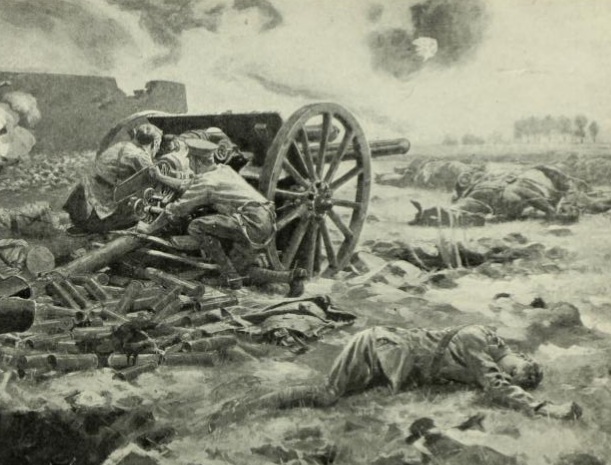
Its not often one can point to a single vehicle or artillery piece and say their actions changed the course of history, however today's article follows the story of one. In an action that won three Victoria Crosses, one gun halted the Germans and gave the allies time to dig in and form a defence line that stopped the Germans during the opening months of the Great War. Without that line its possible the Germans could have driven onto Paris and won World War One in 1914.
I am of course talking about the exploits of Number 6 gun, "L" Battery, Royal Horse Artillery. Today known after the village of Nery, where the battle took place

"L" battery arrived in France as part of the 1st Cavalry Division on 16th of August 1914. On the 24th, "L" battery supported the 9th Lancers mounting their charge at Audrignies. About 1300 in the afternoon the 9th Lancers launched a charge against the Germans to relive pressure on the beleaguered British infantry holding the line. Leaping a sunken road the two squadrons slammed into German lines and scattered the enemy infantry. Despite this success the cavalry took heavy casualties from point blank fire from German field guns and machine guns. In a later action, despite being wounded,  Capt Grenfell won a VC. "L" battery was also strongly praised for its gallantry, having fired all their ammunition stocks in support of the charge. The Battery commander received a DSO for his part.


"L" battery also took part in the battle of Quievrain, and then Le Cateau. At Le Cateau "L" battery deployed along with the rest of the British army in open terrain to meet the Germans. A huge artillery battle developed and although the Germans had been momentarily halted nearly 8000 casualties had been taken by the British.

Days later after taking part in several skirmishes "L" battery found itself bivouacked at Nery. Orders were for the battery to move out at 0430 and continue to retreat. French infantry were holding a plateau to east that over looked Nery. Over night a thick fog formed and the move out was delayed until 0530.
At 0510 the fog suddenly lifted, to reveal the German 4th Cavalry Division on the plateau. The French forces had never been there, and the German scouts had discovered the British encampment over night. As soon as the fog lifted the Germans began shelling the British column ready for march. The opening salvo cut through the men and horses. One of "L" batteries guns over turned and smashed as the horses bolted.
On the Ridge as well as the Division's infantry the Germans had at least two machine guns and twelve field guns in action. all shooting at the short range of 600 to 800 yards.
The commander of "L" battery had been knocked unconscious by the first shots, leaving Battery Captain Bradbury in charge. Yelling "Come on, whose for the guns?!" Cpt Bradbury lead a party of men to the wreckage of the column. They managed to unlimber three of the thirteen pounder guns.

The first gun had its wheels blown off before it could fire a round, rendering it useless. The remaining two guns started to reply to the Germans. After about ten to fifteen minutes the second gun was smashed by the German shells, only Lt Giffard surviving with massive shrapnel injuries that troubled him for the rest of his life.


This left Cpt Bradbury's gun as the only British unit in action against a German Division.

Two Lieutenants, Campbell and Mundy, from the first gun to be knocked out, joined in with Cpt Bradbury's crew. Gunner Darbyshire was in the gunners seat when a shell landed close enough to give him severe concussion, with blood pouring from his ears and nose he was unable to carry on aiming the gun, but refused to retire. He opted to assist Driver Osborne haul ammunition to the gun. The ammo supplies were 20 yards away, with no cover from the murderous German fire.
Lt Campbell took over from Gnr Darbyshire, only to be blown out of the gunners seat and killed by another shell blast.
At this point Battery Sergeant Major Dorrell arrived at the gun and took over the position of gunner. As he arrived Cpt Bradbury was hit, and his leg blown off. Propped up against the wheel of the gun Cpt Bradbury carried on directing the guns fire as best he could until he died from his wounds.
BSM Dorrell and his two reaming crew, Lt Mundy and Sergeant Nelson, kept the gun in action. 


By 0730 the gun had fired around 150 rounds, and no more shells could be found. As Number 6 gun fell silent the German Cavalry were surprised by a flank attack by the 5th Dragoon guards supported by "I" battery RHA. The Germans were in such disorder from the casualties inflicted on them by "L" battery they routed, leaving behind eight field guns at the site of the battle. The German officer ordered his men to scatter as a last ditch attempt to save them. throughout the day the other British units captured the remaining four field guns and at least one machine gun. All abandoned by the fleeing German division.

The guns of the battery were recovered by "I" battery with the help of the 2nd Dragoon Guards, and returned to the Army Ordnance Corp at St Nazaire. Number 6 gun was eventually gifted to the Imperial War Museum, some time between the Museums founding in 1917 and its first opening in 1920. 


The Gun is still on display there, in the same condition it was hauled off the battlefield.. When you get close to it you can see the storm of fire the Germans directed at it. Individual spokes are smashed by bullets, Shrapnel has scoured the gun shield and the barrel has a huge dent in it. The damage to the left wheel is from a shell hit.


For that action the following rewards were given:
Victoria Crosses for Cpt Bradbury, BSM Dorrell and Sgt Nelson.
Legion of Honour for Lt Giffard.
Medaille Miltaire for Gnr Darbyshire and Dvr Osborne.

Thursday, August 8, 2013

[MoO] Space Awaits

Following this post, I assume there are at least some MoO fans around.

This is going to be feedback/brainstorming topic. What new MoO title would you like to play?

  • Genre (strategy, MMO, etc)
  • Platform (s)
  • Distribution (f2p, paid, etc)
  • Particular MoO 1, MoO 2, MoO 3 (o_O) features you liked
  • Visual style and art
  • Anything else 

Give your ideas and remember that every vote counts.